


Pine Nut Guild
- Current Stock:
- 0
- Example of a Native Plant Guild:
- ***For Reference Only - Not For Purchase***
A dry-land food forest for hot, sunny sites: a pine nut tree at the heart, surrounded by tough berries, roots, seeds, and two nitrogen-fixers — built for California and east-side gardens.
What Is a Guild?
A guild is an idea borrowed from nature and from permaculture: a community of plants chosen to support one another. Instead of a lonely row of a single crop, a guild layers a central tree or shrub with companions that feed the soil, draw in pollinators, cover bare ground, and yield food — each sharing light, water, and nutrients the way a small patch of wild woodland or meadow does. Plant one, and you're not just gardening; you're starting a little ecosystem.
The Pine Nut Guild
This guild centers on the Pinyon Pine, one of the most drought-hardy nut trees in North America. (On the mild coast, swap in the Torrey Pine for larger nuts and faster growth.) Around it we add berry shrubs and nitrogen-fixers that thrive on lean, dry soil, and a sunny skirt of roots, grains, and wildflowers that rest through the summer drought.
Plants in This Guild
- Pinyon Pine — centerpiece nut tree (or Torrey Pine on the coast)
- Silver Buffaloberry — nitrogen-fixing berry shrub
- Golden Currant — fruiting shrub
- Blue Blossom or Snowbrush Ceanothus — nitrogen-fixing companion — blue blossom for mild coastal gardens, snowbrush for cold winters
- Soapweed Yucca — edible flowers and young pods
- Balsamroot — edible root, shoots, and seed
- Indian Ricegrass — edible grain
- Wild Blue Flax — wildflower / edible seed
- Oregon Stonecrop — succulent groundcover
These are the plants we'd reach for — mix, match, and add your own. See each plant's own page for full details, and the Planting Guide tab for how to lay the guild out.
Printable Planting Plan
Want the layout on paper? Download and print the Pine Nut Guild planting plan (PDF). It is one letter-size page with the bird's-eye layout, side view, and plant key, so you can keep it handy at planting time.
Ecology & Design
Pinyon woodlands are naturally open and sunny, with shrubs and bunchgrasses scattered between the trees. This guild copies that pattern: the buffaloberry and ceanothus fix nitrogen in poor soil,1 the balsamroot and ricegrass go dormant through the summer drought, and the stonecrop holds water in its leaves. Once established, the whole guild needs little or no summer water.
References
- USDA NRCS Plant Guides (nitrogen-fixing natives: Ceanothus, Shepherdia, Lupinus, Trifolium).
Planting Guide: Pine Nut Guild
Tip: Give the pine the center and full sun, and never shade it — keep the shrubs on the outer ring.
Design & Layout
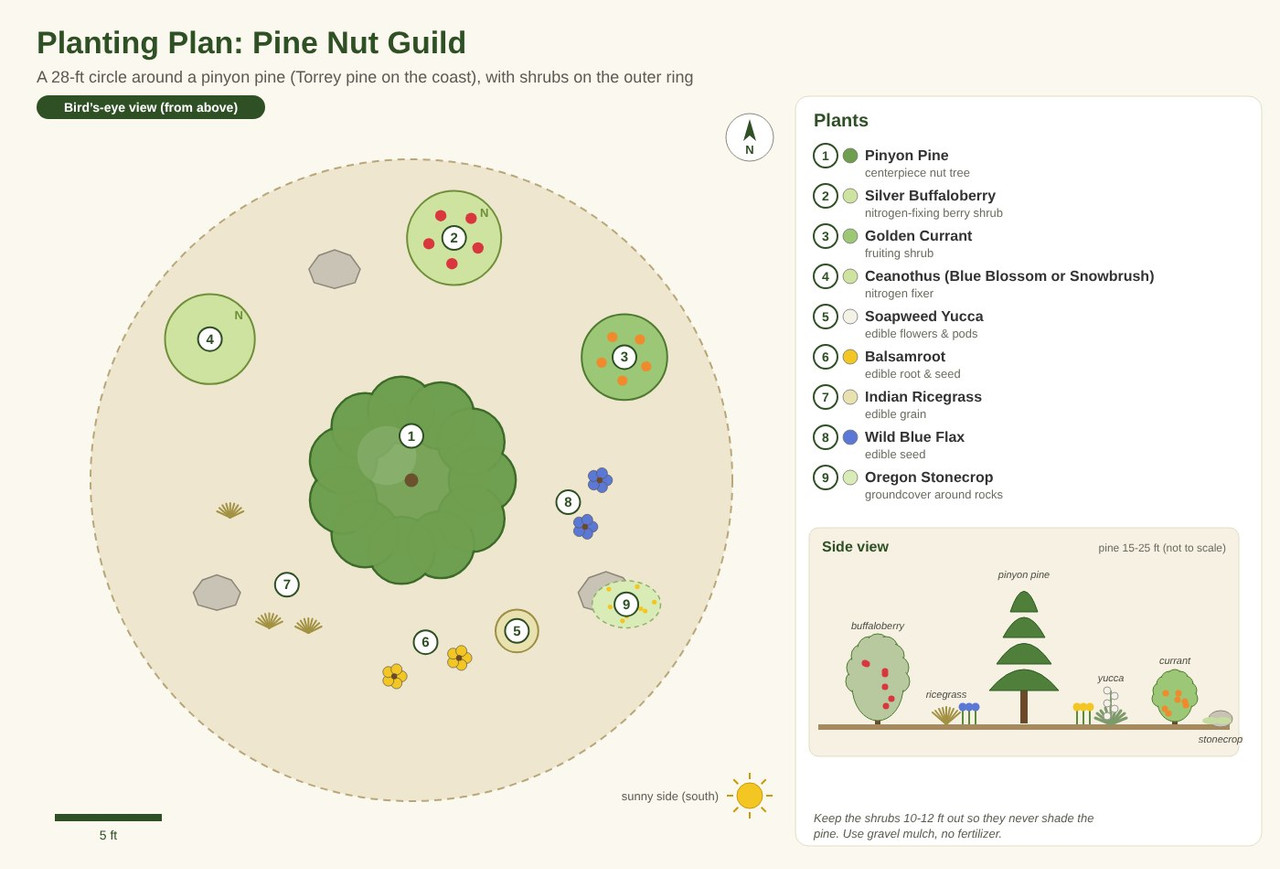
Center: Pinyon Pine as the anchor (Torrey Pine on the mild coast).
Outer ring: Buffaloberry, Golden Currant, and Ceanothus 10–12 ft from the pine.
Between: Soapweed Yucca, Balsamroot, Indian Ricegrass, and Wild Blue Flax in the open, sunny gaps.
Edge: Oregon Stonecrop around rocks and along paths. Plan on roughly a 25–30 ft circle.
Choosing a Site
Light: Full sun.
Soil: Lean, sandy, gravelly, or rocky; very well-drained. Avoid rich or soggy soil.
Water: Low once established.
Zones: Pinyon Pine 5–8; Torrey Pine 8–10; Blue Blossom Ceanothus 8–10 (use Snowbrush in colder areas).
Planting Steps
Plant in fall in mild climates, or in spring where winters are cold.
Don't amend the soil; set the pine slightly high so water drains away from the trunk.
Ring with shrubs, fill the gaps with the perennials and grasses, then water in and mulch with gravel or coarse wood chips.
Care & Establishment
Years one and two: Water deeply but infrequently while roots establish, even though these are drought-tolerant plants.
Feeding: Skip the fertilizer; the buffaloberry and ceanothus supply nitrogen.
Weeding: Keep weeds down the first season or two.
Patience: Pinyon Pine grows slowly and can take many years to bear cones; the berries, roots, and seeds come much sooner.
Guild Notes
Nut set: Planting two or more pines improves pollination and nut production.
Harvest: Cones ripen in fall; collect them as they begin to open.
Companion: Ceanothus is a soil-builder; use its leaves for tea, not as a food crop.
