


Edible Hedgerow Guild
- Current Stock:
- 0
- Example of a Native Plant Guild:
- ***For Reference Only - Not For Purchase***
A living fence that feeds you: a row of native fruiting shrubs for privacy, wind, and wildlife, with berries from early summer into fall.
What Is a Guild?
A guild is an idea borrowed from nature and from permaculture: a community of plants chosen to support one another. Instead of a lonely row of a single crop, a guild layers a central tree or shrub with companions that feed the soil, draw in pollinators, cover bare ground, and yield food — each sharing light, water, and nutrients the way a small patch of wild woodland or meadow does. Plant one, and you're not just gardening; you're starting a little ecosystem.
The Edible Hedgerow Guild
This guild is built in a line instead of a circle. Saskatoon Serviceberry and Blue Elderberry form the tall backbone, currants and Oso berry fill the middle, a nitrogen-fixing ceanothus keeps the soil rich, strawberries soften the sunny front edge, and salal, violets, and redwood sorrel fill the shady strip behind the tall row. In three to four years it grows into a dense screen along a property line, driveway, or fence.
Plants in This Guild
- Saskatoon Serviceberry — backbone fruiting shrub
- Blue Elderberry — tall fruiting shrub (cook the berries)
- Golden Currant — fruiting shrub
- Red-flowering Currant — early-blooming fruiting shrub for pollinators
- Oso Berry — early-fruiting shrub
- Thimbleberry — berry shrub for the shadier side
- Salal — evergreen berry shrub for the shady side; keeps the hedge green in winter
- Snowbrush Ceanothus — nitrogen-fixing companion — leaves for tea
- Mountain Strawberry — edible groundcover along the sunny front edge
- Early Blue Violet — edible flowers and greens in the shade behind the hedge
- Redwood Sorrel — tangy groundcover green for the moist, shady spots
These are the plants we'd reach for — mix, match, and add your own. See each plant's own page for full details, and the Planting Guide tab for how to lay the guild out.
Printable Planting Plan
Want the layout on paper? Download and print the Edible Hedgerow Guild planting plan (PDF). It is one letter-size page with the bird's-eye layout, side view, and plant key, so you can keep it handy at planting time.
Ecology & Design
A hedgerow is one of the oldest edible landscapes there is: a mixed row of shrubs that blocks wind and sightlines while feeding people, birds, and pollinators. Staggering the shrubs makes the screen thicker, the different bloom times keep bees fed from March into summer, and the ceanothus fixes nitrogen for its neighbors.1 The shady north side, usually bare ground under a hedge, becomes a second layer of food. Most of these shrubs are hardy from coastal California to eastern Washington.
References
- USDA NRCS Plant Guides (nitrogen-fixing natives: Ceanothus, Shepherdia, Lupinus, Trifolium).
Planting Guide: Edible Hedgerow Guild
Tip: Plant in a staggered double row, not a single line — the screen fills in faster and looks more natural.
Design & Layout
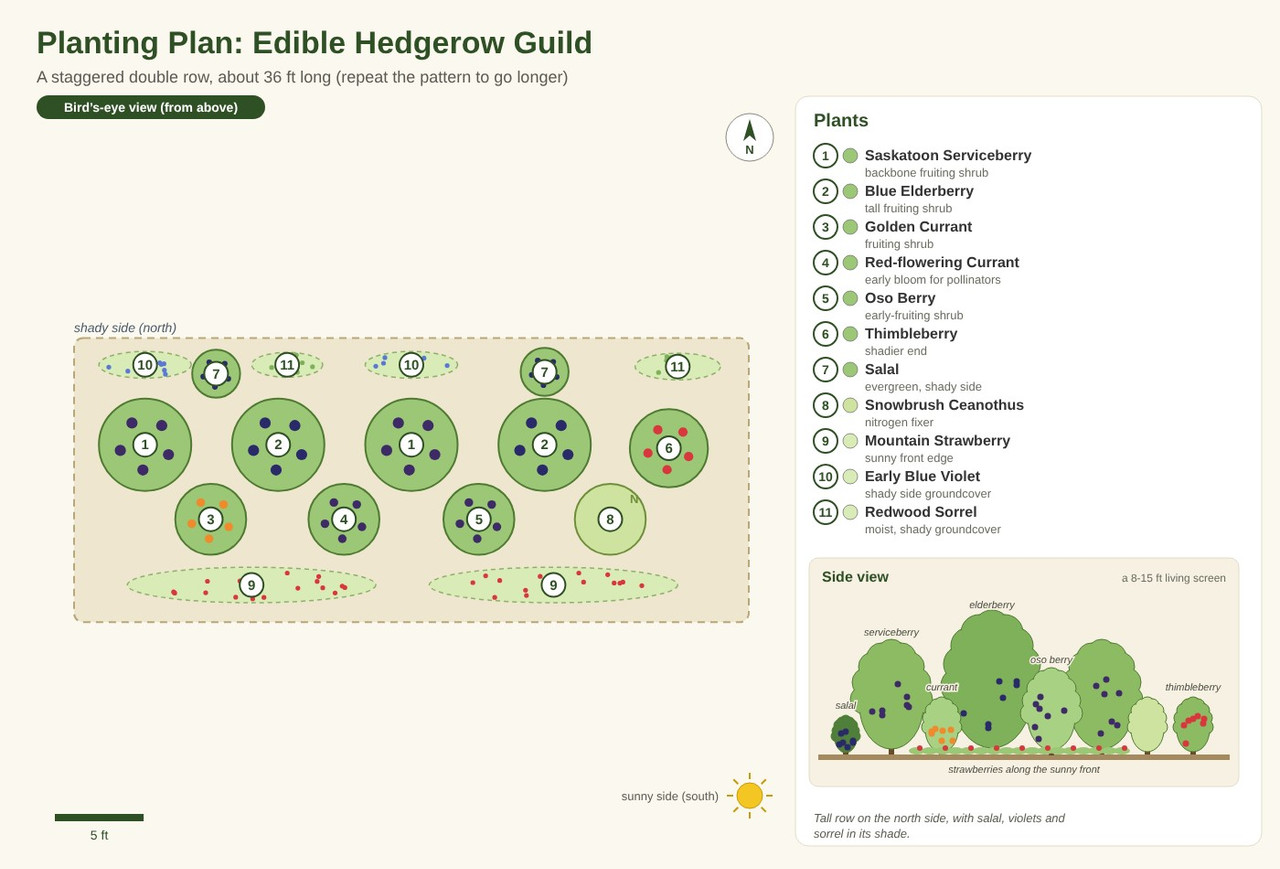
Back row: Saskatoon Serviceberry and Blue Elderberry, 6–8 ft apart (on the north or far side).
Front row: Currants, Oso Berry, and Snowbrush Ceanothus, 4–6 ft apart, offset from the back row.
Shady end: Thimbleberry where the row runs into shade.
Shady side: Salal between the back-row shrubs on the north side, with Early Blue Violet and Redwood Sorrel as groundcover in the shade (sorrel in the moistest spots).
Front edge: Mountain Strawberry in the sun. Plan on roughly 30–40 ft of row for one of each shrub; repeat the pattern to go longer.
Choosing a Site
Light: Full sun to part shade.
Soil: Most well-drained garden soils.
Water: Moderate the first two summers, then low to moderate.
Planting Steps
Mark the line and plant the back row in fall or spring.
Offset the front row between the back-row shrubs; tuck the ceanothus in a sunny gap.
Plant the strawberries along the sunny front edge and the violets and sorrel on the shady side, then water in and mulch.
Care & Establishment
Year one: Water regularly while everything roots in, even drought-tolerant plants.
Mulch: Mulch bare soil (leaf mold, wood chips) until the shrubs and groundcovers close in.
Weeding: Keep weeds down the first season or two; after that the hedge largely shades them out.
Patience: Expect a real screen in about three to four years.
Guild Notes
Pruning: Cut a few of the oldest elderberry and Oso berry stems each winter to keep the hedge dense and productive.
Wildlife: Leave some berries for the birds; a hedgerow is as much habitat as harvest.
Salal: Slow for the first year or two, then spreads into an evergreen layer that keeps the hedge screening through winter.
Companion: Snowbrush Ceanothus is a soil-builder; use its leaves for tea, not as a food crop.
