


Grape Arbor Guild
- Current Stock:
- 0
- Example of a Native Plant Guild:
- ***For Reference Only - Not For Purchase***
A shady place to sit that feeds you: grapevines trained over an arbor or pergola, with strawberries, wildflowers, and a soil-building lupine growing underneath.
What Is a Guild?
A guild is an idea borrowed from nature and from permaculture: a community of plants chosen to support one another. Instead of a lonely row of a single crop, a guild layers a central tree or shrub with companions that feed the soil, draw in pollinators, cover bare ground, and yield food — each sharing light, water, and nutrients the way a small patch of wild woodland or meadow does. Plant one, and you're not just gardening; you're starting a little ecosystem.
The Grape Arbor Guild
This guild is built around a structure instead of a tree. Grapevines climb an arbor, pergola, or sturdy fence to make summer shade and fall fruit, while the ground beneath them becomes a low, productive carpet. Choose our cold-hardy table or wine grapes for big harvests, or wild California grape for a looser, wilder arbor in warm climates.
Plants in This Guild
- Table Grapes or Wine Grapes — centerpiece vines (or Wild Grapes for California and the desert)
- Coastal Strawberry — edible groundcover for the sunny side
- Woodland Strawberry — edible groundcover for the shady side under the arbor
- Nodding Onion — edible bulb along the edges
- Wild Blue Flax — wildflower / edible seed along the sunny edge
- Henderson's Checkermallow — edible wildflower
- Lupine — nitrogen-fixing companion — not for eating
These are the plants we'd reach for — mix, match, and add your own. See each plant's own page for full details, and the Planting Guide tab for how to lay the guild out.
Ecology & Design
Grapes are hungry, sun-loving vines, and an arbor lets them reach the light while leaving the ground free for other plants. The strawberries shade the soil and keep it cool, the wildflowers bring in pollinators and beneficial insects, and the lupine adds nitrogen.1 Two or three vines are enough to cover a typical 8–10 ft arbor.
References
- USDA NRCS Plant Guides (nitrogen-fixing natives: Ceanothus, Shepherdia, Lupinus, Trifolium).
Planting Guide: Grape Arbor Guild
Tip: Build the arbor first and make it sturdy — a mature grapevine laden with fruit is heavy.
Design & Layout
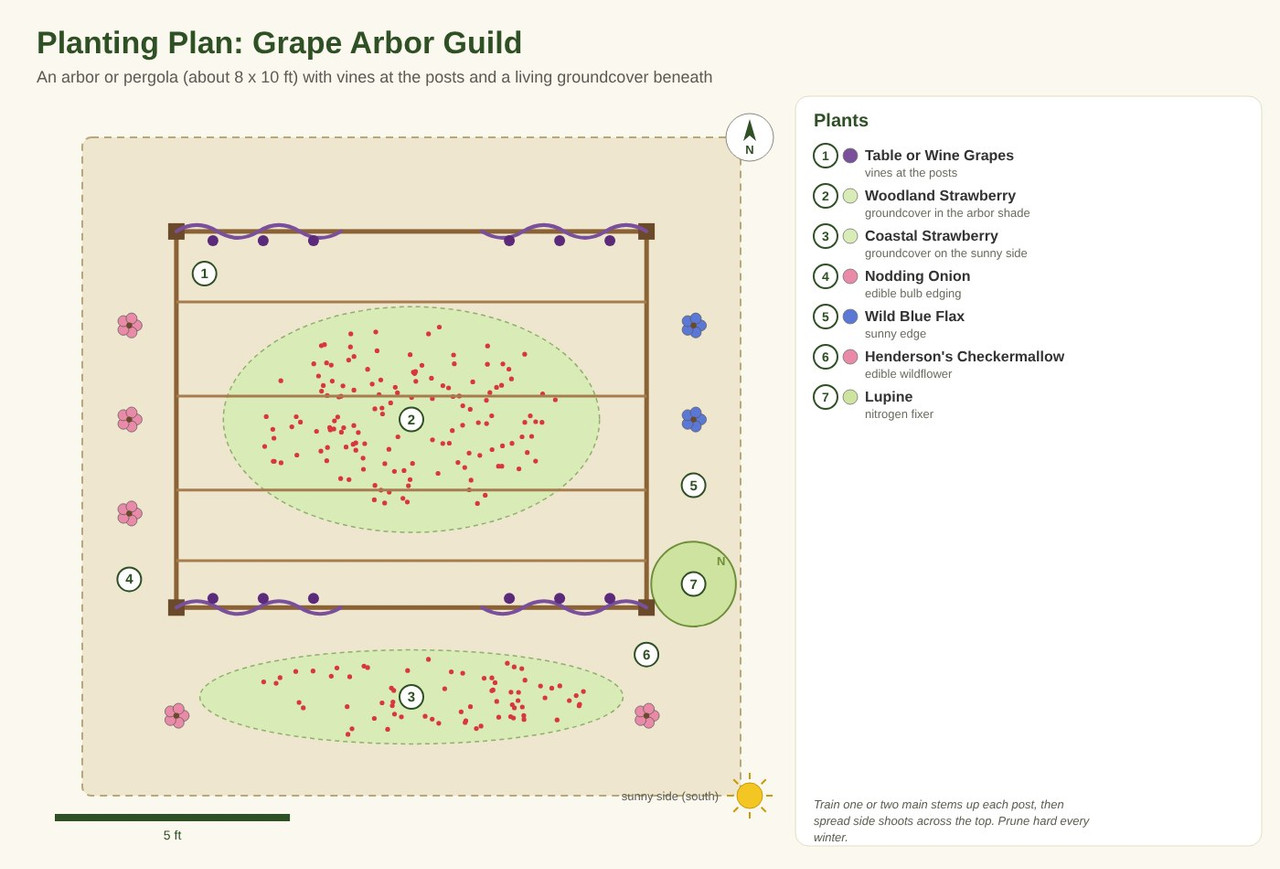
Structure: An arbor, pergola, or strong fence at least 7 ft tall, in full sun.
Vines: Two or three grapevines, one at each post, about 6–8 ft apart.
Groundcover: Coastal Strawberry on the sunny side, Woodland Strawberry in the shade beneath the arbor.
Edges: Nodding Onion, Wild Blue Flax, Checkermallow, and Lupine along the sunny edges. Plan on roughly a 10 x 12 ft area.
Choosing a Site
Light: Full sun on the vines; the groundcover can take the shade underneath.
Soil: Well-drained garden soil.
Water: Moderate; deep, infrequent watering once established.
Zones: Table and wine grapes 4–8; Wild California grape 7–10.
Planting Steps
Plant the vines in late winter or early spring at the base of each post.
Plant the strawberries and edge plants around them, then water in and mulch.
Tie the young vines to the posts as they grow.
Care & Establishment
Year one: Water regularly while everything roots in, even drought-tolerant plants.
Mulch: Mulch bare soil (leaf mold, wood chips) until the groundcovers close in.
Weeding: Keep weeds down the first season or two; after that the guild largely mulches itself.
Training: Let one or two main stems climb the post; once they reach the top, spread side shoots across the arbor.
Guild Notes
Pruning: Prune grapes hard every winter, cutting last year’s side shoots back to two buds; this keeps the arbor tidy and productive.
Harvest: Most of our grapes ripen from late August through September.
Companion: Lupine is a soil-builder, not a food.
