Plant Guilds
Some of the most beautiful, resilient, and productive plantings in nature aren't single plants at all — they're communities. A guild is that idea, borrowed from permaculture: a central tree or shrub surrounded by companions that feed the soil, draw in pollinators, cover the ground, and yield food, all sharing light, water, and nutrients the way a patch of wild woodland or meadow does. Plant one, and you're not just gardening — you're starting a little ecosystem.
Each guild page shows the plants, how they support one another, and a planting guide for laying it out.
Jump to all 12 guilds ↓Guild bonus: buy every in-stock plant in a guild and get an extra 7% off, on top of bulk discounts.
Ecological guilds
- Oak Savanna — regrow a patch of one of North America's most endangered habitats, an edible oak savanna, in your own yard.
- Huckleberry Patch — a little piece of Northwest forest edge: four native huckleberries around old logs, with salal, sorrel, and violets below.
- Edible Hedgerow — a living fence of native fruiting shrubs for privacy, wind, and wildlife.
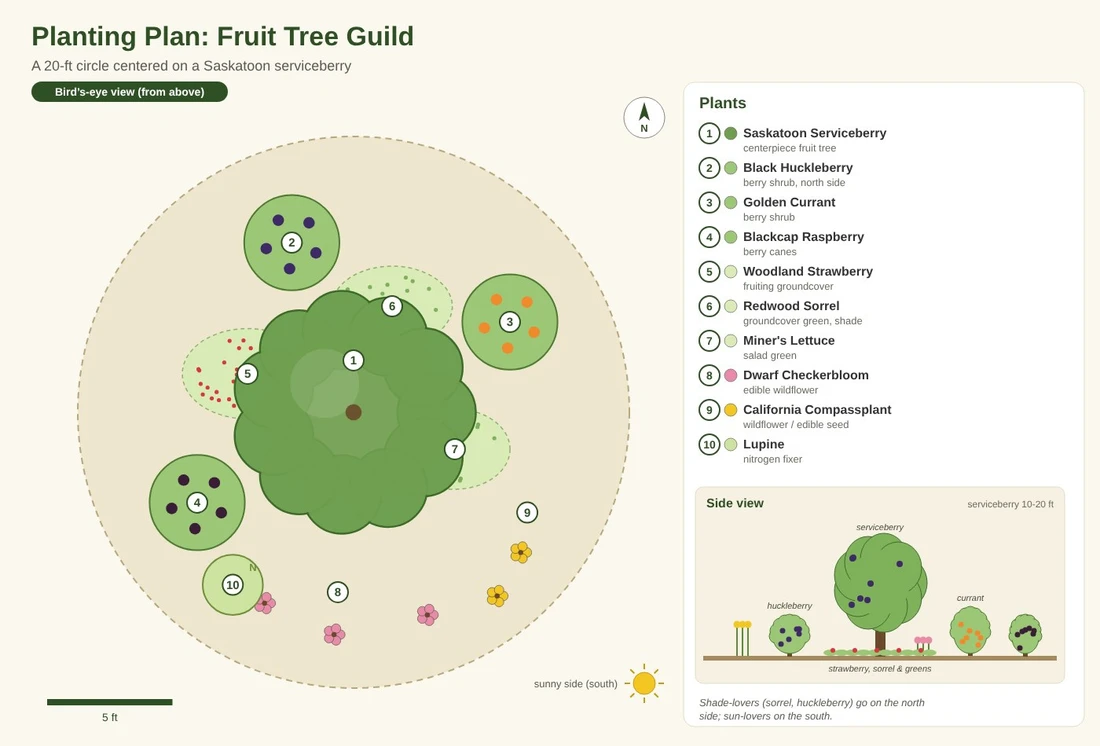
- Fruit Tree — an edible ecosystem around one fruit tree, with berries, wildflowers, greens, and a nitrogen-fixer feeding the soil.
- Nut Tree — a classic Northwest nut tree wrapped in berries, greens, and a soil-building companion.
- Clay Soil Orchard — a native orchard for heavy clay and damp soils, with Pacific crabapple, highbush cranberry, and a spring meadow of camas.
- Pine Nut — a dry-land food forest for hot, sunny sites in California and east of the Cascades.
- Coastal — a tough, wind- and salt-tolerant planting for ocean-front gardens from California to Washington.
Just-for-fun guilds
- Kids' Snacking Garden — thornless berries, strawberries along a stepping-stone path, and greens and edible flowers kids can pick themselves.
- Elderberry Syrup — a cluster of elderberries planted together for heavy crops, so you can make your own syrup.
- Grape Arbor — a shady place to sit that feeds you, with grapevines over an arbor and strawberries, wildflowers, and lupine underneath.
- Small-Space — a compact native food garden for a patio, side yard, or 10 x 10 ft bed.
Think of these as blueprints and inspiration rather than fixed kits. Because our stock shifts with the seasons, you'll add each plant to your cart from its own page — so use a guild as a starting point, then mix, match, and make it your own. Want to build your own? Try the plant finder.