


Coastal Guild
- Current Stock:
- 0
- Example of a Native Plant Guild:
- ***For Reference Only - Not For Purchase***
A tough, wind- and salt-tolerant planting for ocean-front gardens from California to Washington, with a pine nut tree, evergreen berry shrubs, and a groundcover that thrives in sandy soil.
What Is a Guild?
A guild is an idea borrowed from nature and from permaculture: a community of plants chosen to support one another. Instead of a lonely row of a single crop, a guild layers a central tree or shrub with companions that feed the soil, draw in pollinators, cover bare ground, and yield food — each sharing light, water, and nutrients the way a small patch of wild woodland or meadow does. Plant one, and you're not just gardening; you're starting a little ecosystem.
The Coastal Guild
Coastal gardens face wind, salt spray, sandy soil, and summer fog. This guild centers on the Torrey Pine, a rare coastal pine with large edible nuts, and surrounds it with the evergreen berry shrubs of Northwest and California coastal forests: salal and evergreen huckleberry. Blue blossom ceanothus and lupine fix nitrogen, and coastal strawberry covers the ground.
Plants in This Guild
- Torrey Pine — centerpiece nut tree (zones 8–10)
- Salal — evergreen berry shrub, very wind tolerant
- Evergreen Huckleberry — evergreen berry shrub for the sheltered side
- Blue Blossom Ceanothus — nitrogen-fixing companion — a top early pollinator plant
- Salmonberry — berry shrub for moist, sheltered spots
- Coastal Strawberry — edible groundcover that tolerates sand and salt spray
- Oregon Stonecrop — succulent groundcover for rocky, exposed spots
- Lupine — nitrogen-fixing companion — not for eating
These are the plants we'd reach for — mix, match, and add your own. See each plant's own page for full details, and the Planting Guide tab for how to lay the guild out.
Ecology & Design
On the coast, plants protect one another. The pine and the dense evergreen shrubs break the wind, creating a sheltered pocket where huckleberry and salmonberry can fruit. The ceanothus and lupine add nitrogen to sandy, nutrient-poor soil,1 and the strawberry and stonecrop hold the sand in place.
References
- USDA NRCS Plant Guides (nitrogen-fixing natives: Ceanothus, Shepherdia, Lupinus, Trifolium).
Planting Guide: Coastal Guild
Tip: Put the toughest plants (pine, salal, ceanothus) on the windward side to shelter everything else.
Design & Layout
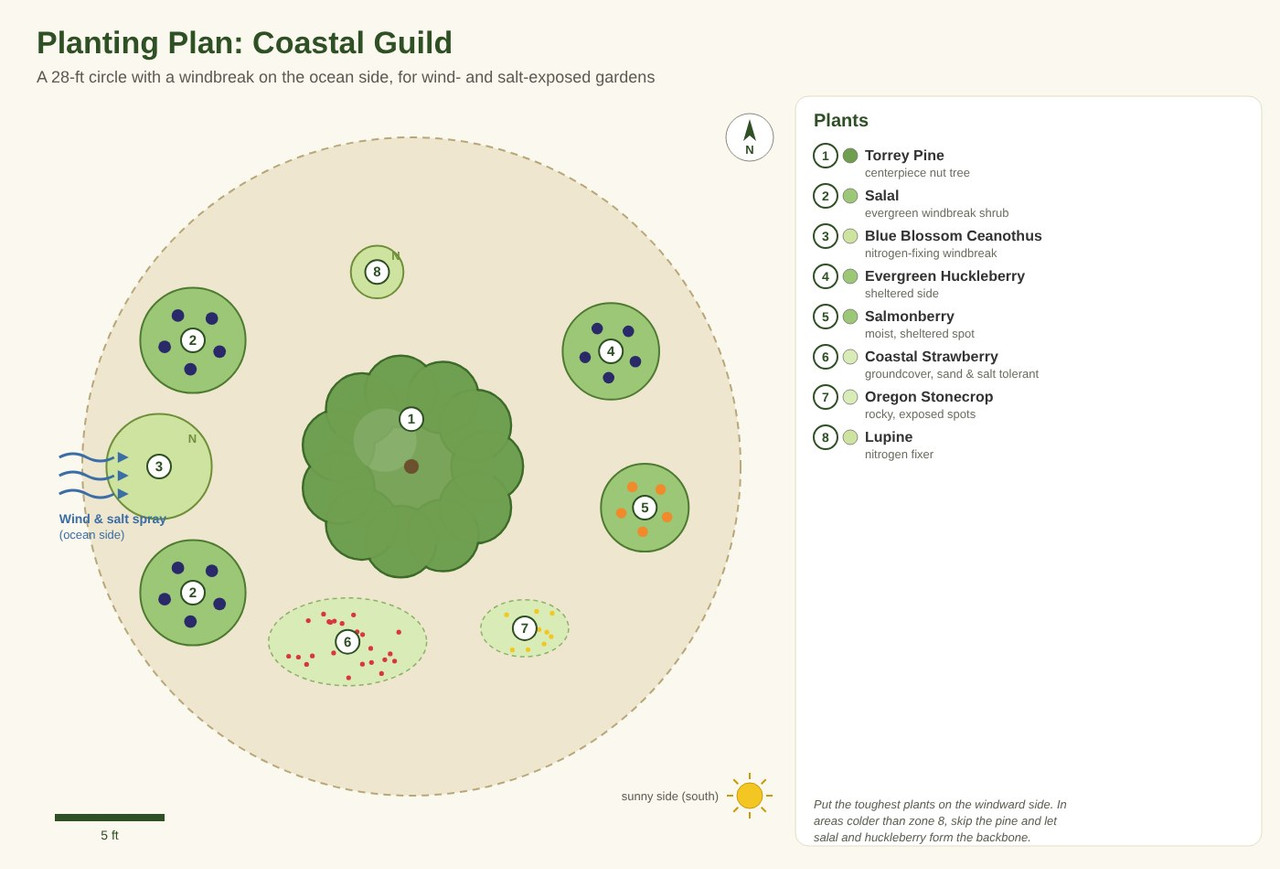
Center: Torrey Pine as the anchor, in full sun.
Windward side: Salal and Blue Blossom Ceanothus as a living windbreak.
Sheltered side: Evergreen Huckleberry and Salmonberry in the lee of the windbreak.
Floor: Coastal Strawberry and Oregon Stonecrop, with Lupine in sunny gaps. Plan on roughly a 25–30 ft circle.
Choosing a Site
Light: Full sun to part shade.
Soil: Sandy or well-drained; tolerates salt spray.
Water: Low to moderate once established; coastal fog helps.
Zones: Torrey Pine and Blue Blossom Ceanothus 8–10. In colder coastal areas, skip the pine and let salal and evergreen huckleberry form the backbone.
Planting Steps
Plant in fall or early spring.
Plant the windbreak shrubs first, then the pine and the sheltered shrubs.
Fill in with the groundcovers, then water in and mulch.
Care & Establishment
Year one: Water regularly while everything roots in, even drought-tolerant plants.
Mulch: Mulch bare soil (leaf mold, wood chips) until the groundcovers close in.
Weeding: Keep weeds down the first season or two; after that the guild largely mulches itself.
Wind: Stake the young pine loosely for its first year or two.
Guild Notes
Nuts: Torrey Pine grows faster than most pines but still takes years to bear cones.
Companion: Ceanothus and lupine are soil-builders, not food crops.
