


Huckleberry Patch Guild
- Current Stock:
- 0
- Example of a Native Plant Guild:
- ***For Reference Only - Not For Purchase***
A little piece of Northwest forest edge that feeds you: four kinds of native huckleberry growing around two old logs, with salal, sorrel, violets, and strawberries filling in below.
What Is a Guild?
A guild is an idea borrowed from nature and from permaculture: a community of plants chosen to support one another. Instead of a lonely row of a single crop, a guild layers a central tree or shrub with companions that feed the soil, draw in pollinators, cover bare ground, and yield food — each sharing light, water, and nutrients the way a small patch of wild woodland or meadow does. Plant one, and you're not just gardening; you're starting a little ecosystem.
The Huckleberry Patch Guild
This guild copies the way huckleberries grow in the wild: on and around rotting wood, in cool, acidic, leafy soil. Two half-buried logs anchor the bed, and every huckleberry is planted right up against one so its roots can grow into the rotting wood. Red Huckleberry sits on the end of a log, oval-leaf takes the shady north side, evergreen grows between the logs, and black huckleberry hugs the sunny south side. Salal keeps it green all winter, and sorrel, violets, and strawberries cover the ground. Plant several kinds together and you'll be picking from early summer into fall.
Plants in This Guild
- Red Huckleberry — bright red berries; planted on the end of a log
- Evergreen Huckleberry — evergreen backbone; late-season berries
- Oval Leaf Huckleberry — early blue berries for the cool, moist north side
- Black Huckleberry — the classic mountain huckleberry, for the sunniest side
- Salal — evergreen berry shrub that fills the gaps
- Redwood Sorrel — tangy groundcover green for the shade
- Early Blue Violet — edible flowers and greens between the logs
- Woodland Strawberry — fruiting groundcover for the sunny front edge
These are the plants we'd reach for — mix, match, and add your own. See each plant's own page for full details, and the Planting Guide tab for how to lay the guild out.
Printable Planting Plan
Want the layout on paper? Download and print the Huckleberry Patch Guild planting plan (PDF). It is one letter-size page with the bird's-eye layout, side view, and plant key, so you can keep it handy at planting time.
Ecology & Design
Huckleberries are forest plants. In the wild they root into rotting logs and stumps, which hold moisture, stay acidic, and are full of the fungi their roots depend on. Rotted wood in the soil measurably improves huckleberry growth.1 The logs here do the same job: it soaks up winter rain and slowly feeds the bed for years. Mixing species spreads the harvest out, since oval-leaf huckleberries ripen first and evergreen huckleberries can hang on the bush into November.
References
- Barney, D. L., Growing Western Huckleberries, University of Idaho Extension, 1999.
Planting Guide: Huckleberry Patch Guild
Tip: Start with the logs. Lay both down, half buried, before you plant anything else, and set every huckleberry right up against one.
Design & Layout
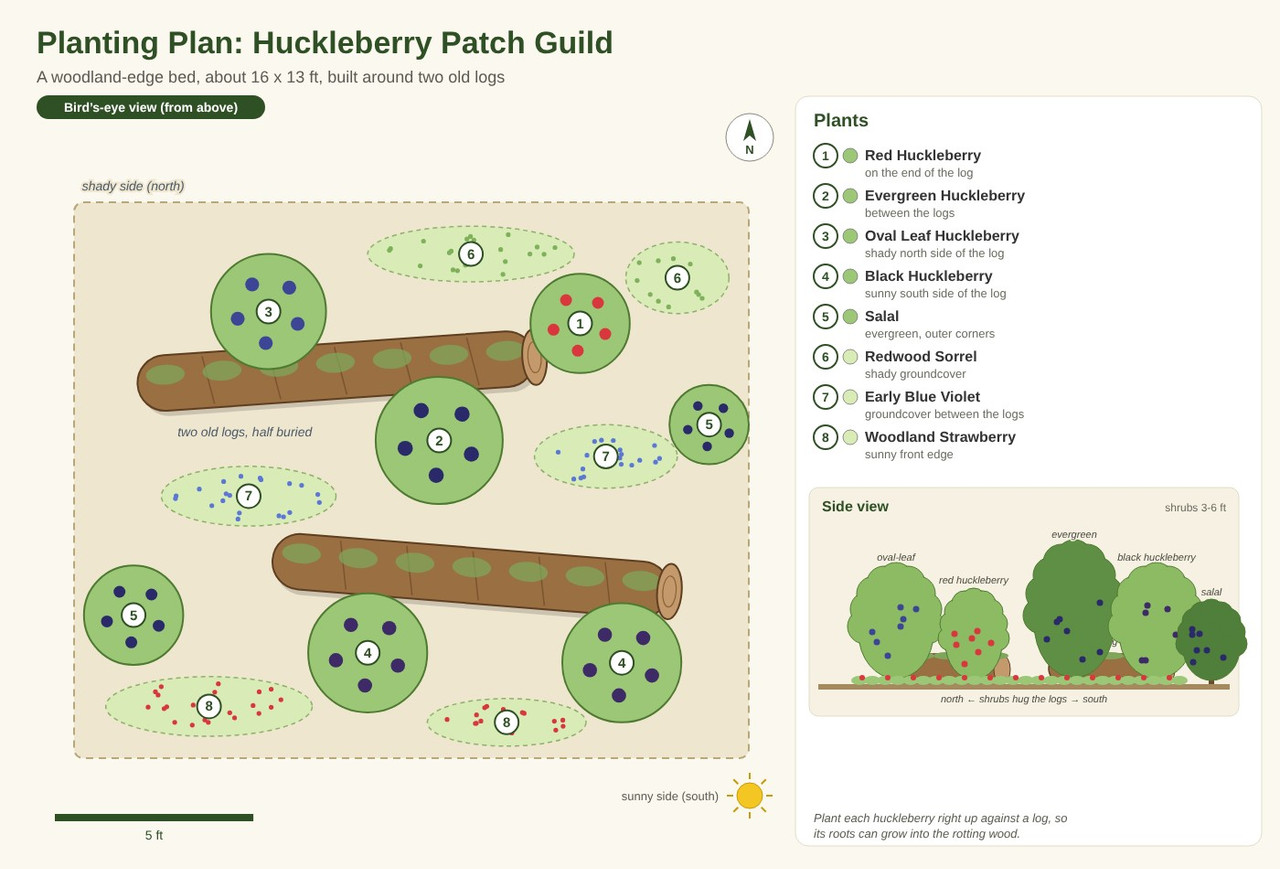
Logs: Two rotting logs (or a log and a few old stumps), half buried, running across the bed about 4–5 ft apart.
North side: Oval Leaf Huckleberry tight against the shady north side of the first log, with Redwood Sorrel in the deepest shade behind it.
On the log: Red Huckleberry on the end of the first log, where it can root into the wood.
Between the logs: Evergreen Huckleberry against the first log, with Early Blue Violet filling the gaps.
South side: Black Huckleberry tight against the sunny south side of the second log, Salal in the outer corners, and Woodland Strawberry along the front edge. Plan on a bed about 16 x 13 ft.
Choosing a Site
Light: Part shade to dappled sun, like a forest edge. Black huckleberry wants the most sun; sorrel and oval-leaf take the most shade.
Soil: Strongly acidic (about pH 4.5–5.5), moist, well-drained, and full of organic matter. Mix in rotted sawdust, bark, or leaf mold, and never add lime.
Water: Steady moisture; huckleberries don't tolerate drought.
Planting Steps
Lay the two logs first, half buried, and mix rotted wood, bark, or leaf mold into the soil around them. Ideally do this a year ahead.
Plant each huckleberry within about a foot of a log, in fall or spring, so its roots can grow into the wood. Give each one an ericoid mycorrhizal inoculant (or a shovelful of soil from a wild huckleberry patch) at planting.
Fill in the sorrel, violets, and strawberries, then water in and mulch 3–4 inches deep with conifer needles, bark, or sawdust.
Care & Establishment
Year one: Keep evenly moist, never soggy, and never let the huckleberries wilt hard.
Feeding: Feed lightly with feather meal or half-strength acid fertilizer; the fungi that feed huckleberries are suppressed by heavy feeding.
Weeding: Roots are shallow, so hand-weed and don't cultivate deeper than about 2 inches.
Patience: Huckleberries are slow. Expect first berries in 3–5 years and a full patch in 10 or more.
Guild Notes
Fresh wood: Use rotted wood in the soil. Fresh sawdust or wood chips mixed in will tie up nitrogen for a year or two.
Frost: Avoid low frost pockets; huckleberry blossoms are damaged below about 28°F.
Harvest order: Oval-leaf first (early summer), then red and black huckleberry (mid to late summer), and evergreen huckleberry last (fall).
