



Oval Leaf Huckleberry
- Current Stock:
- 0
- Other Names:
- Oval Leaf Huckleberry, Oval-leaved Blueberry, Oval-leaf Bilberry
- Latin Name:
- Vaccinium ovalifolium
The Oval Leaf Huckleberry (Vaccinium ovalifolium) is a Northwest native shrub with sweet, blue, deliciously healthy berries — in our humble opinion (and the bears'), a rival to Black Huckleberry for the finest wild berry in the West.2, 4
Edible & Medicinal Uses
Also called Oval Leaf Blueberry, this close cousin of the Black Huckleberry bears a sweet blue berry prized for both fresh eating and cooking. Make it into jams, freeze it, cook it into fruit leathers, or dry it into huckleberry "raisins." The berries are high in vitamins A, B, and C and rich in antioxidants.3 A note on wild plants: grown from wild seed, these shrubs carry wide genetic diversity, so they vary in flavor, productivity, and site preference — some fruit best at lower elevations, others higher, and low-elevation fruit can be milder. (Research toward a productive low-elevation cultivar is underway; we'll carry it when it's ready.)1
Ornamental Qualities
Oval Leaf Huckleberry has elegant, thin leaves — rounder and flatter than Black Huckleberry's — that emerge translucent spring-green and glow red and purple in fall. Modest, urn-shaped, creamy-pink flowers open in late spring, and the young bark is yellow-green, aging to a shredding gray. It pairs beautifully under a California Foothill Pine or Oregon White Oak, with acid-loving ferns like Fiddlehead Fern or Spreading Wood Fern, or with Blue Blossom Ceanothus (just don't let it shade out your berries).1
Environment & Culture
Ecology: Oval Leaf Huckleberry grows in moist, conifer-dominated forests and subalpine meadows across the northern US and Canada, spreading by rhizomes into patches that can live over a century.4 Young plants are a favorite of deer, and the berries are important food for many birds and mammals — so protect fruit with netting if you want a share. Once established in a good spot, the plant is hardy and drought-tolerant.1, 2
Culture: Oval Leaf Huckleberry is a culturally important plant that many Native peoples tend and gather — eating the berries fresh, dried, mashed, cooked into soup, frozen, pressed into cakes, and stored for winter — and continuing to steward and restore wild Vaccinium populations today. We offer it with respect for that living knowledge and invite support for Indigenous-led restoration through our Charitable Giving page.3
In the Kitchen
Use it anywhere you'd use a blueberry — fresh by the handful, frozen, dried, or baked into jams, cobblers, crisps, and leathers. Many find the flavor superior to cultivated blueberries, if a touch smaller and less abundant, so a summer's watering (for bigger berries) and a little patience pay off. (Growing and harvest details are on the Planting Guide tab.)
Attributes
- Native Range: CA, OR, WA, BC, ID, AK; moist forests, subalpine meadows1
- USDA Zones: ~5–93
- Light: Full sun to part shade (best fruit ~60–70% sun)1
- Water: Moist; drought-hardy once established1
- Soil: Acidic, well-drained, humus-rich1
- Habit: Deciduous shrub, 3–6 ft; slow-growing2
- Edible: Sweet blue berries (fresh, dried, cooked)4
References
- Native Foods Nursery field notes; USDA PLANTS, Vaccinium ovalifolium.
- Pojar, J. & MacKinnon, A., Plants of the Pacific Northwest Coast, 2014.
- Moerman, D., Native American Ethnobotany, 1998.
- USDA Forest Service, Fire Effects Information System (FEIS), Vaccinium ovalifolium.
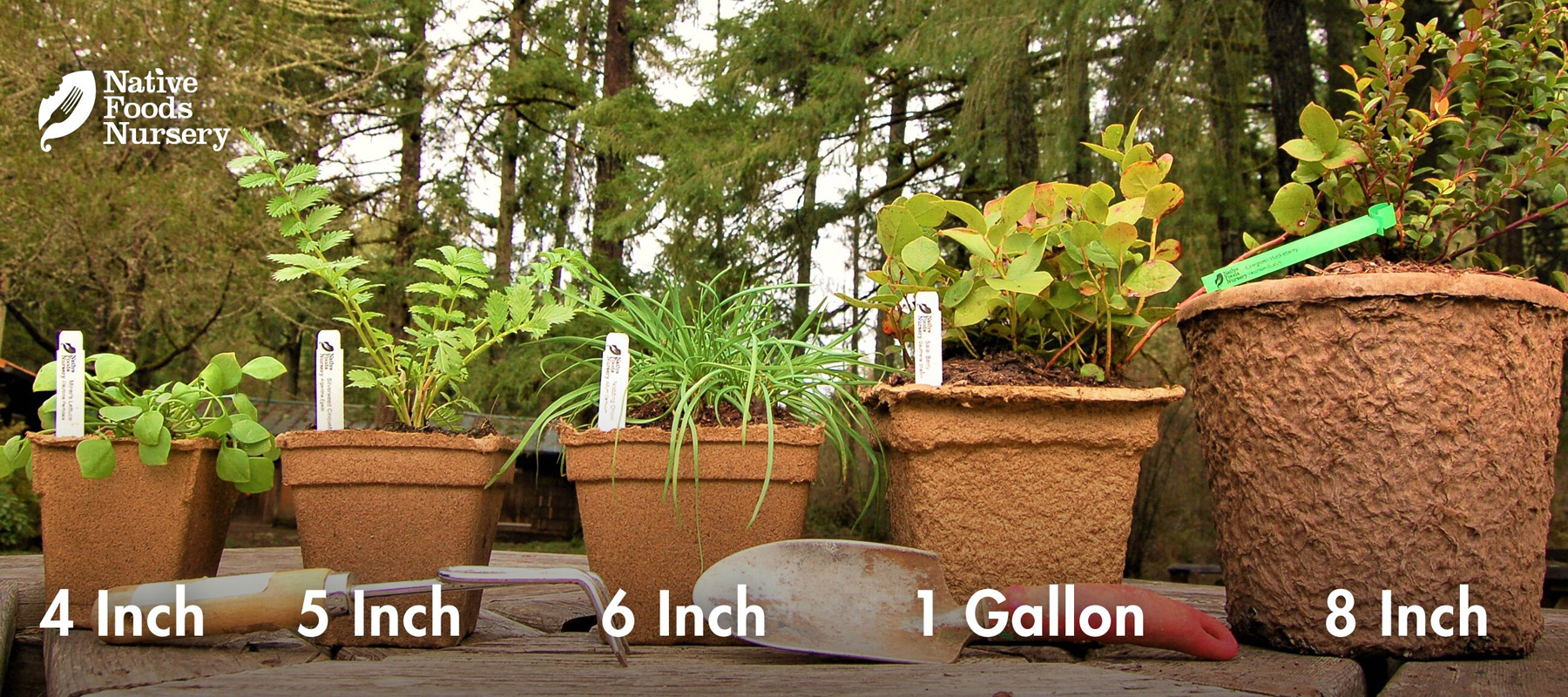
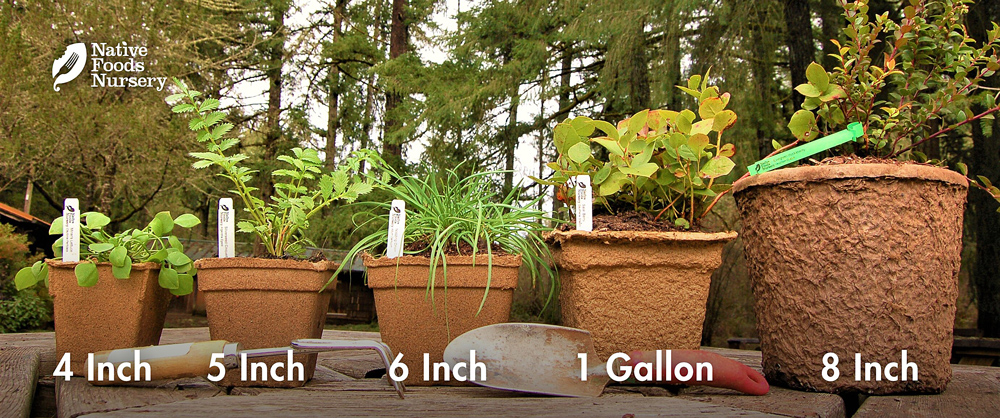
Pot Sizing Guide
Planting Guide: Oval Leaf Huckleberry (Vaccinium ovalifolium)
Tip: Treat it like a blueberry — it needs acidic, humus-rich, well-drained soil and is slow to establish, so amend with peat or composted conifer needles, mulch well, and be patient.
When Your Plant Arrives
Open the box promptly and lift your plant out gently, holding the pot rather than the stem. Leave it in its biodegradable eco-pot for now — the roots are settled and don’t need disturbing yet. Give it a slow, thorough drink until water runs through the bottom, then set it somewhere bright but sheltered, out of harsh afternoon sun, drying wind, and frost. Let it rest and acclimate there for a few days before planting, so the move from our greenhouse to your garden is a gentle one. If anything doesn’t look right, please contact customer service within 7 days of delivery and we’ll take care of you.
Choosing a Site
Light: Full sun to part shade (best fruit around 60–70% sun).
Soil: Acidic (about pH 4.5–5.5), humus-rich, and well-drained.
Making it acidic: Mulch alone won’t lower a neutral or alkaline soil enough. Ahead of planting, work elemental (soil) sulfur into the bed at the label rate and give it a few months to react, blend in peat moss and composted conifer bark or needles, and feed with an organic acidic (rhododendron/azalea/berry) fertilizer. Check pH with an inexpensive meter and top up sulfur as needed — acidifying is gradual and ongoing. Where the ground stays stubbornly alkaline, grow it in a raised bed or large container of acidic mix instead.
First-years shade: A montane species from cool, high forest openings — hot valley sun scorches young plants. Give it a forest edge or dappled light (or temporary shade cloth) and deep mulch for the first few years, likely longer at low elevations.
Space: 3–5 ft apart.
Planting Steps
Plant in spring or fall into acidified, humusy soil.
If it came in a biodegradable eco-pot, plant it pot and all — the pot is pressed from composted cow manure, so it melts into the soil and gives the young roots their first feed. No need to remove it.
Set at the depth it grew, firm gently, and water in. Site it away from paths — the roots dislike compaction.
Mulch with bark or conifer needles.
Watering & Care
Establishment: Slow-growing — keep evenly moist and give careful attention early.
After establishment: Drought-hardy once settled; summer water makes bigger berries.
Maintenance: Keep it mulched, avoid compacting the root zone, and refresh acidic mulch yearly.
Protection
Deer: Fond of young plants — fence or cage until established.
Birds: Net if you want a share of the fruit.
Soil: Won’t thrive in alkaline ground — keep the pH low.
Harvest Basics
Season: Berries ripen July–August, shifting purple to dark blue (firm with a little give).
Use: Sweet and versatile — fresh, frozen, dried, or in jams, cobblers, and leathers.
