




Salal Berry
- Current Stock:
- 0
- Other Names:
- Evergreen Blueberry, Wintergreen, Shallon, sxelálen (Straits Salish, pronounced “skhuh-LAH-len”)
- Latin Name:
- Gaultheria shallon
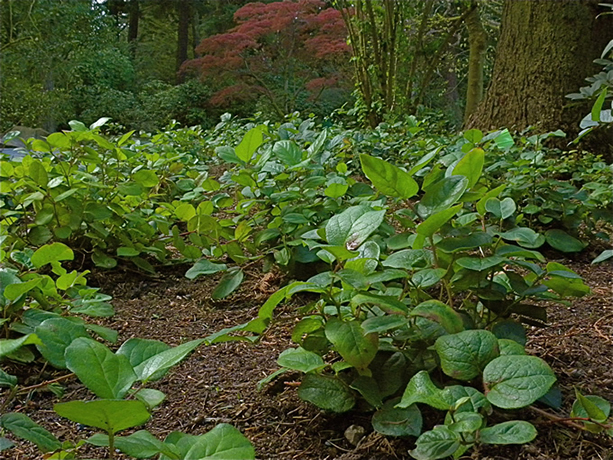
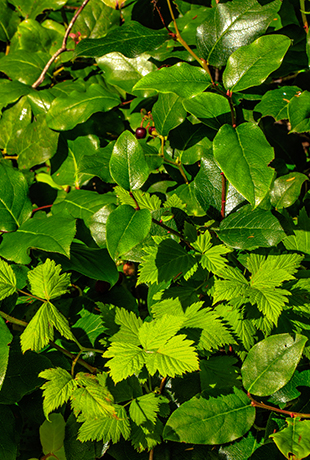
Salal is one of the Pacific Northwest’s most iconic understory evergreens—its glossy leaves, pink-white spring blossoms, and dusky blue fruits bring year-round life and flavor to the forest edge.
Edible Uses
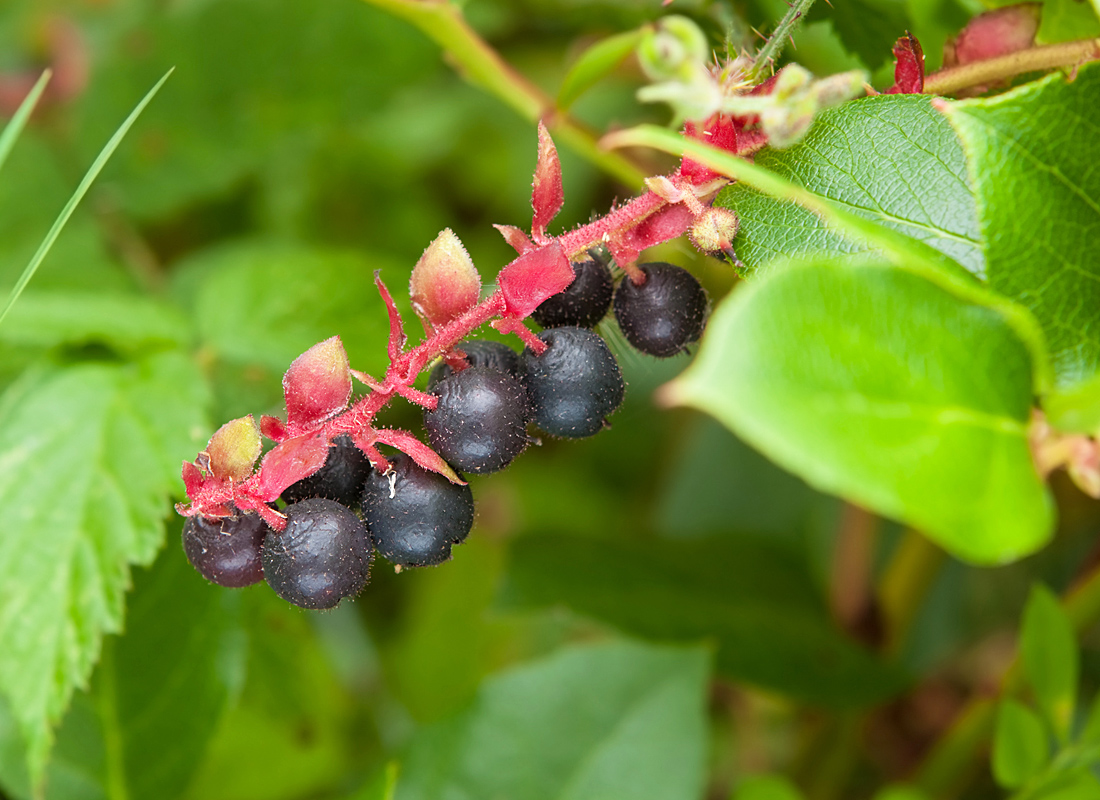
The dark berries are sweet with a rich, winey flavor and can be eaten fresh, made into jams, or mashed and dried into fruit “cakes” for long storage [1]. Their high polyphenol and anthocyanin content gives them both deep color and notable antioxidant value [2]. The young leaves were also sometimes brewed as a mild tea [3].
Ornamental Qualities
Salal is prized as a lush evergreen groundcover and cut-foliage plant, widely used in floral arrangements [4]. Its compact habit and tolerance for shade make it ideal beneath other trees such as Pacific Crab Apple, Oregon White Oak, or even our native pine nuts. The urn-shaped flowers bloom in spring and give way to dark berries that contrast beautifully with leathery foliage.
Environment and Culture
Ecology: A keystone shrub of the coastal temperate rainforest, Salal grows from northern California to Alaska in conifer understories, forest edges, and coastal dunes [5]. It stabilizes soil, shelters small wildlife, and provides nectar for native bees and hummingbirds [6].
Culture: Salal is honored as a First Food among Coast Salish, Nuu-chah-nulth, and other Northwest peoples, who continue to harvest and tend it as both nourishment and teacher [7]. The English name “salal” comes directly from sx̣əlálen in SENĆOŦEN. We honor their enduring relationship with this plant and invite support for Indigenous-led restoration (see our Charitable Giving page).
Harvest, Care, and Preparation
Once established, Salal needs little care beyond light summer watering in its first year. It thrives in acidic, well-drained soils and partial shade. Harvest berries when they turn deep purple and soft to the touch (late summer–early fall).
→ For detailed guidance, see the Planting Guide tab.
In the Kitchen
Salal berries are sweet and winey — eat them fresh, cook them into jam and syrup, or mash and dry them into traditional fruit “cakes” for winter storage. They're wonderful in a mixed native-berry preserve, and the young leaves make a mild tea.
Attributes
- Native Range: CA, OR, WA, BC [1]
- USDA Zones: 5–10 [1]
- Ease of Care: Easy
- Deer Resistance: Moderate–High [4]
- Light Requirements: Shade to full sun; more shade in southern climates, more sun in northern [1][5]
- Soil Type: Acidic, well-drained, humus-rich [5]
- Water Requirements: Moist to moderately dry; drought-tolerant once established [5]
- Pollination: Self-fertile
- Bearing Age: 2–3 years
- Size at Maturity: 1–6 ft tall, spreading 3–8 ft [4]
- Bloom Time: May–June
- Harvest Time: August–October
- Indigenous Names: sx̣əlálen (SENĆOŦEN — “skhuh-LAH-len”), sxʷəláɬən (Hul’q’umi’num’ — “skhwuh-LAH-thun”), šʔaʔił (Nuu-chah-nulth — “SHAH-eelth”) [7]
References
[1] USDA PLANTS Database, Gaultheria shallon.
[2] Hummer, C., “Phenolics and Antioxidant Capacity in Gaultheria shallon,” J. Food Comp. Anal., 2010.
[3] Turner, N. J., Food Plants of Coastal First Peoples, 1995.
[4] Oregon State University, Landscape Plants: Gaultheria shallon.
[5] Pojar, J. & MacKinnon, A., Plants of the Pacific Northwest Coast, 2014.
[6] USFS Plant Guide, Gaultheria shallon.
[7] Moerman, D., Native American Ethnobotany, 1998.
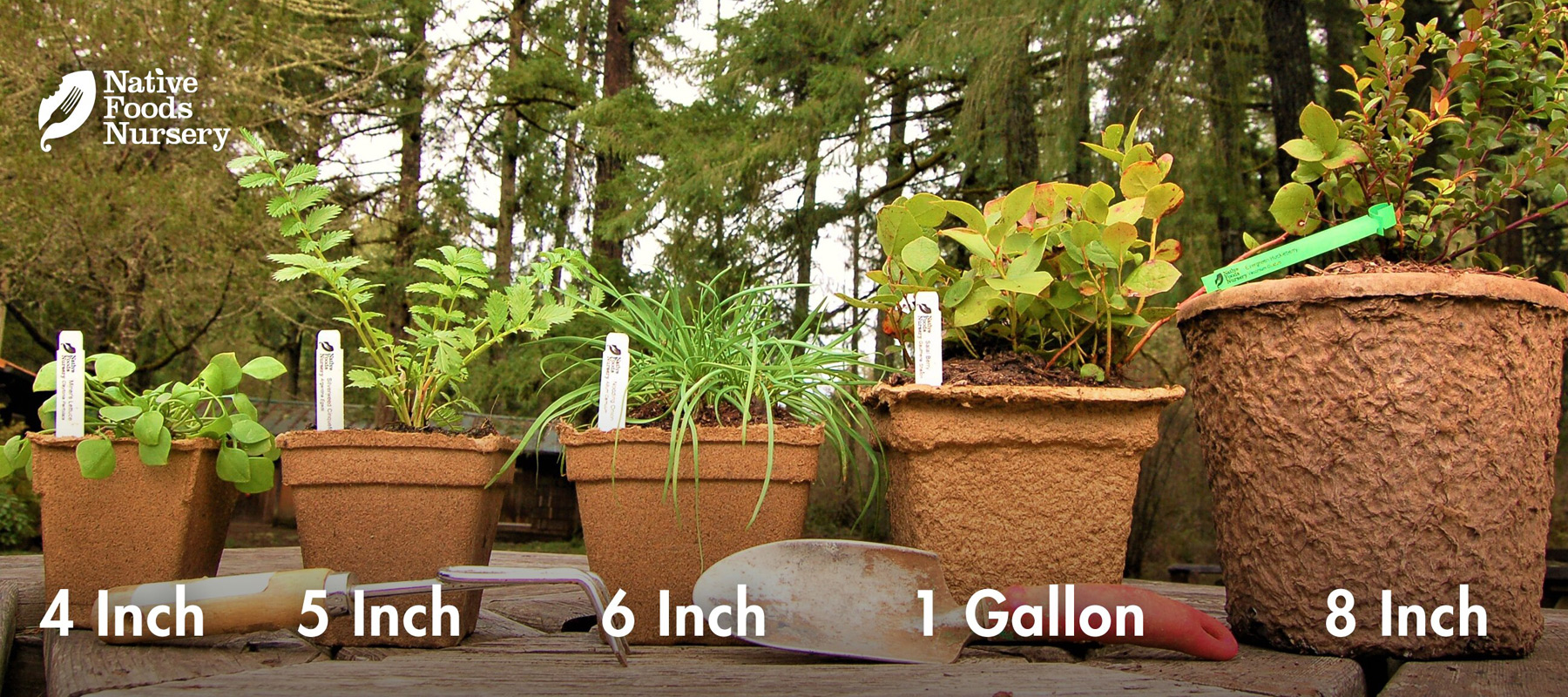
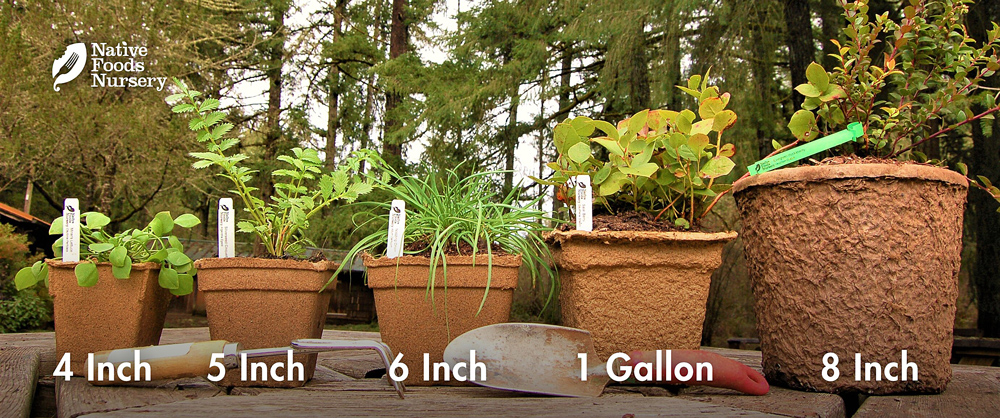
Pot Sizing Guide
Planting Guide: Salal (Gaultheria shallon)
Tip: Think “forest edge.” Salal thrives at the boundary of light and shade—along paths, under tall conifers, or on north and east slopes where duff collects. Mimic these natural conditions for effortless success.
When Your Plant Arrives
Open the box promptly and lift your plant out gently, holding the pot rather than the stem. Leave it in its biodegradable eco-pot for now — the roots are settled and don’t need disturbing yet. Give it a slow, thorough drink until water runs through the bottom, then set it somewhere bright but sheltered, out of harsh afternoon sun, drying wind, and frost. Let it rest and acclimate there for a few days before planting, so the move from our greenhouse to your garden is a gentle one. If anything doesn’t look right, please contact customer service within 7 days of delivery and we’ll take care of you.
Choosing a Site
Light: Partial to full shade inland and in the south; part to full sun along the coast or in cooler northern gardens.
Soil: Well-drained, humus-rich, and acidic — salal is in the heath family, alongside the huckleberries.
Making it acidic: It wants acid ground, though it is less fussy than blueberries. Blend in peat, composted conifer bark, or needles, mulch with conifer duff, and use an acidic (rhododendron/azalea) organic feed; add a little elemental sulfur where soil is neutral or alkaline.
Space: 2–4 ft apart; it spreads slowly by rhizome into dense evergreen mats.
Planting Steps
Plant in fall (best) or early spring while the soil is cool and moist.
If it came in a biodegradable eco-pot, plant it pot and all — the pot is pressed from composted cow manure, so it melts into the soil and gives the young roots their first feed. No need to remove it.
Dig a hole twice the root ball’s width but no deeper; set at the depth it grew, firm, and water in. Mulch with conifer needles or bark.
Watering & Care
Establishment: Years 1–2, keep evenly moist — a deep soak every 7–10 days in dry spells beats constant light watering.
After establishment: Fairly drought-tolerant in shade once settled.
Pruning & spread: Prune lightly after fruiting or in late winter; cut leggy stems to the base to rejuvenate. It spreads slowly — divide rhizomes or take semi-ripe cuttings to make more.
Protection
Deer: Browsed only lightly — a tough, shade-loving groundcover under conifers.
Wildlife: Dense mats shelter birds and small mammals; the flowers feed bumblebees and hummingbirds.
Harvest Basics
Season: Fruit ripens late summer into early fall, turning dark blue-black and slightly soft.
Technique: Pick by hand or gently rake the clusters.
Use: Sweet with a rich, winey flavor — eat fresh, cook into jam, or (traditionally) mash and dry into fruit “cakes” for long storage. The evergreen foliage is also prized in arrangements.
