



Evergreen Huckleberry
- Current Stock:
- 0
- Other Names:
- Winter Huckleberry, California Huckleberry, EeEelac (Puget Sound Salish, pronounced “ee-EEL-ahk”)
- Latin Name:
- Vaccinium Ovatum
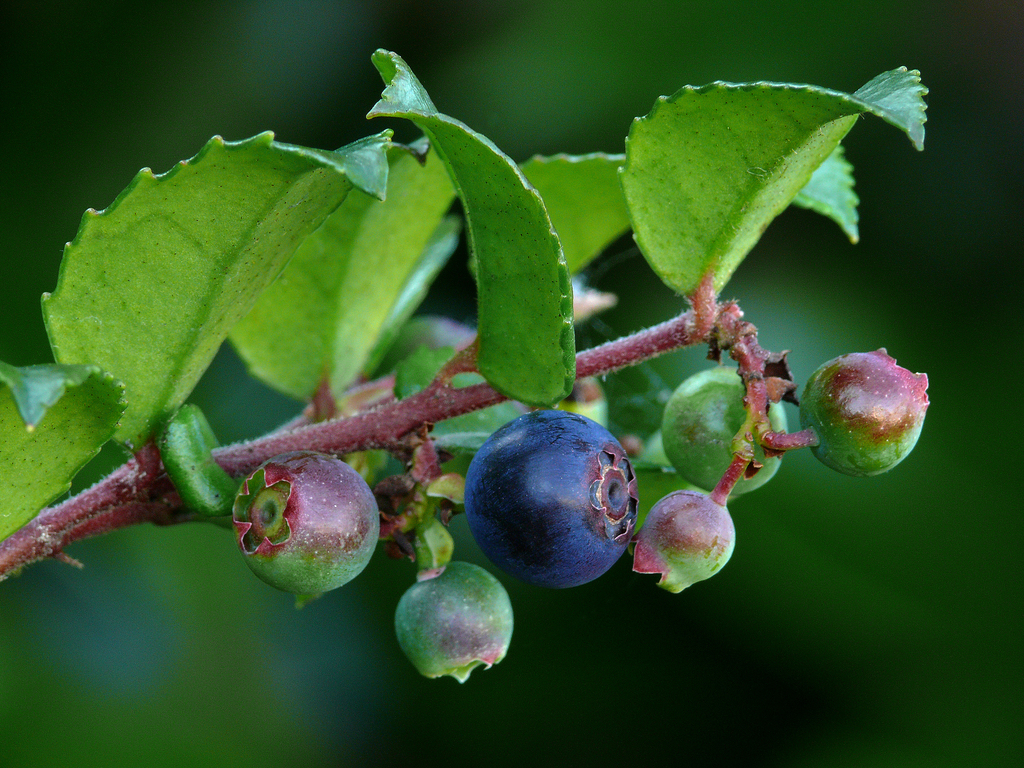
Evergreen Huckleberry (Vaccinium ovatum) is a jewel of the coastal Northwest, offering glossy green foliage, pink-tinged spring flowers, and late-season black berries. It’s arguably the easiest and most adaptable huckleberry for gardeners and—unlike most others—keeps its foliage year-round, making it both ornamental and edible [1][4][8]. It’s no wonder it’s one of our most popular plants!
Edible Uses
The small, but prolific, black berries are enjoyed fresh, cooked, or dried and make excellent jams, jellies, and preserves [5][9]. Sweeter even than Black Huckleberry[11], they also contain anthocyanins and other polyphenols with notable antioxidant capacity, along with supportive vitamins [10].
Ornamental Qualities
Compact and adaptable, Evergreen Huckleberry works as a hedge, container plant, or woodland understory shrub. Glossy leaves, pink spring flowers, and black fruit provide four-season interest [4][7]. Pairs well with Salal and Lingonberry for a low-growing, evergreen edible border.
Environment and Culture
Native from coastal British Columbia to central California, often flourishing on acidic soils along forest edges and coastal scrub [1][2][3]. It provides late nectar for pollinators and abundant fruit for birds and wildlife [6][8]. Indigenous communities continue to harvest and tend Evergreen Huckleberry as a valued food and cultural plant. Acknowledging Indigenous stewardship affirms living traditions and ecological knowledge that sustain both the plant and the places it grows [5][9]. (Learn more & how to help on our Charitable Giving page.)
Harvest, Care, and Preparation
Plant in acidic, well-drained soil; tolerant of shade and salt spray. Water regularly during establishment, then reduce. For best crops, aim for 6+ hours of sun (give afternoon shade in hot inland sites); deep shade reduces fruiting [4][7]. In many sites, flavor peaks after the first light frost—harvest when berries are deep black and fully flavored, before a hard freeze [7].
(See planting guide in next tab for more details)
In the Kitchen
Sweeter than most, these late berries shine fresh but also cook into glossy jam and jelly, pie, and syrup. Because they ripen well into fall (and a light frost only deepens their sweetness), they're a favorite for late-season preserves and holiday baking.
Attributes
Native Range: BC → WA/OR → central CA (coastal forests, edges, scrub)
USDA Zones: 7–9 (some sites 6 with protection/microclimate)
Ease of Care: Easy–Moderate
Deer Resistance: Moderate
Light Requirements: Full sun to full shade (best fruit with 6+ hours; give afternoon shade in hot inland sites)
Soil Type: Strongly acidic, well-drained, organic-rich; avoid alkaline soils
Water Requirements: Summer-dry tolerant once established; best fruit with steady summer moisture
Pollination: Self-fertile; bee activity improves set
Bearing Age: ~2–4 years from planting
Size at Maturity: ~4–8 ft (larger in mild coastal sites; can be kept 3–5 ft with pruning)
Plant Spacing: 3–5 ft (2–3 ft for a tight hedge)
Bloom Time: April–June
Harvest Time: August–October (often later on the coast)
References
[1] USDA PLANTS Database — species profile.
[2] Flora of North America — taxon treatment.
[3] Jepson eFlora — California distribution & habitat notes.
[4] Oregon State University Landscape Plants — horticultural notes.
[5] Moerman, Native American Ethnobotany — Indigenous food use.
[6] USFS Plant Guides — wildlife value & ecological roles.
[7] Native Plant Network & Extension publications — cultivation guidance.
[8] Pojar & MacKinnon, Plants of the Pacific Northwest Coast — ecology & natural history.
[9] Turner, Food Plants of Coastal First Peoples — cultural tending & food use.
[10] Peer-reviewed nutrition/phytochemistry — anthocyanins, polyphenols, vitamins; antioxidant capacity.
[11] Lee, J., Finn, C.E., & Wrolstad, R.E. (2004). Comparison of anthocyanin pigment and other phenolic compounds of Vaccinium membranaceum and Vaccinium ovatum native to the Pacific Northwest of North America. Journal of Agricultural and Food Chemistry 52(23): 7039–7044.
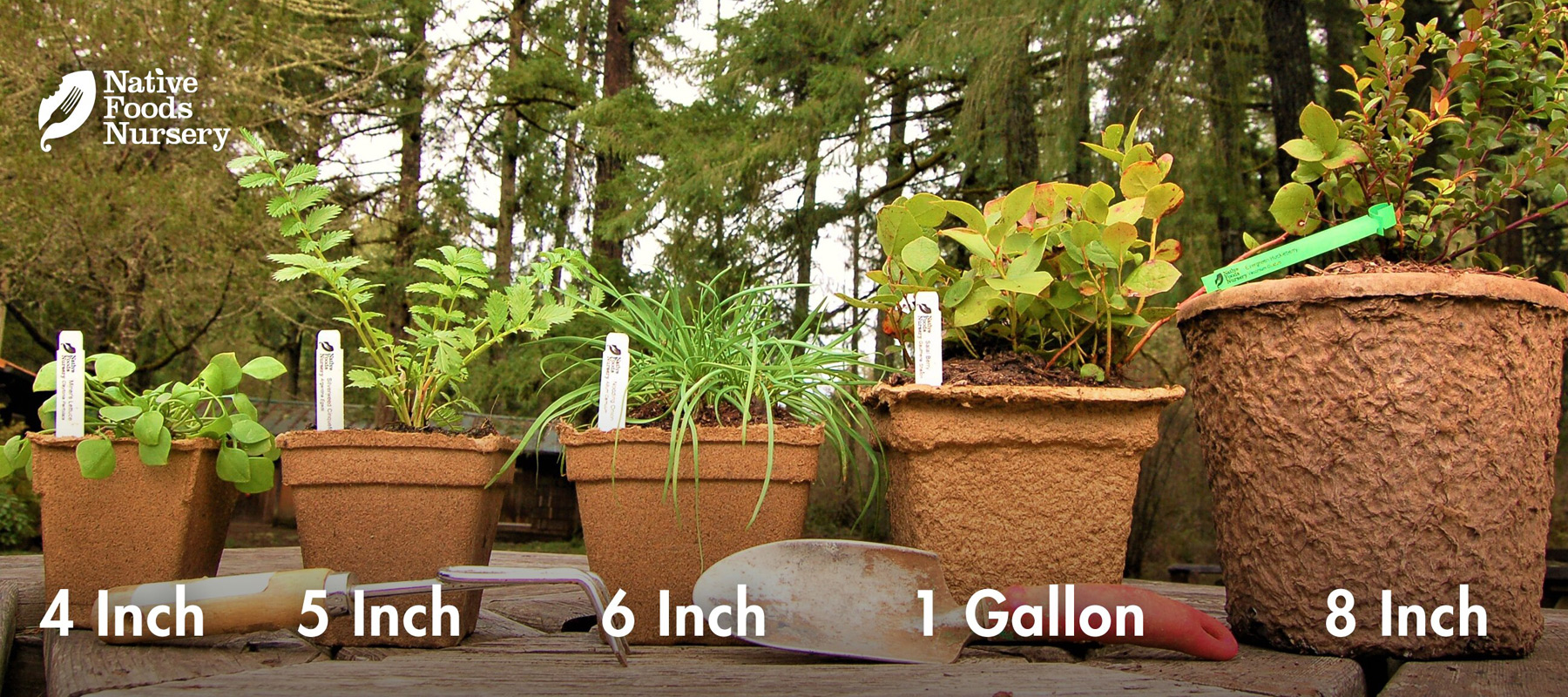
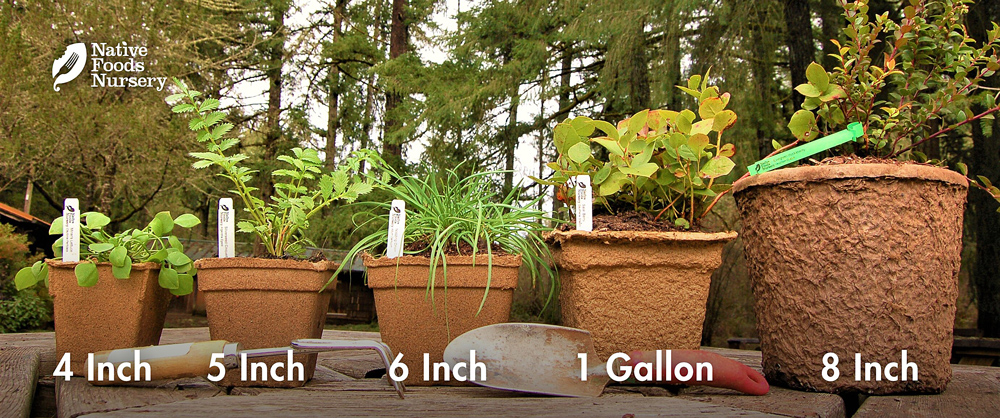
Pot Sizing Guide
Planting Guide: Evergreen Huckleberry (Vaccinium ovatum)
Tip: Think “coastal forest edge.” Use acidic, organic-rich soil and a conifer-duff mulch; in hot inland sites give afternoon shade and steady summer water for best crops.
When Your Plant Arrives
Open the box promptly and lift your plant out gently, holding the pot rather than the stem. Leave it in its biodegradable eco-pot for now — the roots are settled and don’t need disturbing yet. Give it a slow, thorough drink until water runs through the bottom, then set it somewhere bright but sheltered, out of harsh afternoon sun, drying wind, and frost. Let it rest and acclimate there for a few days before planting, so the move from our greenhouse to your garden is a gentle one. If anything doesn’t look right, please contact customer service within 7 days of delivery and we’ll take care of you.
Choosing a Site
Light: Full sun to full shade — one of the few berries that fruits even in deep shade, though 6+ hours of sun gives the best crop. In hot inland gardens, give it afternoon shade.
Soil: Strongly acidic (about pH 4.5–6), well-drained, organic-rich; blend in fine bark, conifer needles, or leaf mold.
Making it acidic: Mulch alone won’t lower a neutral or alkaline soil enough. Ahead of planting, work elemental (soil) sulfur into the bed at the label rate and give it a few months to react, blend in peat moss and composted conifer bark or needles, and feed with an organic acidic (rhododendron/azalea/berry) fertilizer. Check pH with an inexpensive meter and top up sulfur as needed — acidifying is gradual and ongoing. Where the ground stays stubbornly alkaline, grow it in a raised bed or large container of acidic mix instead.
Space: 3–5 ft apart; a handsome glossy evergreen that doubles as a hedge or understory shrub.
Planting Steps
Plant in fall or spring (spring in cold-winter regions, fall in hot-summer ones).
If it came in a biodegradable eco-pot, plant it pot and all — the pot is pressed from composted cow manure, so it melts into the soil and gives the young roots their first feed. No need to remove it.
Dig a wide hole and amend the backfill with composted bark or leaf mold; set at the depth it grew, firm, and water in.
Mulch with conifer needles or bark to feed the acidity and keep the shallow roots cool.
Watering & Care
Establishment: Keep evenly moist (not waterlogged) the first one to two years; a slow starter, so be patient.
After establishment: Tolerates summer dryness in shade, but the best fruit comes with steady summer moisture.
Soil & feeding: Refresh acidic mulch yearly; yellowing between leaf veins signals the soil is drifting alkaline. Prune only lightly after fruiting to shape.
Protection
Birds: Relish the fruit — drape lightweight netting as berries color if you want a share.
Deer & cold: Hardy roughly USDA 7–9 (sometimes 6 in mild pockets); protect young plants from browse where deer press.
Companions: Salal, red and Cascade huckleberry, and other acid-loving woodland natives.
Harvest Basics
Timeline: First light crops about 2–4 years after planting.
Season: Late summer into fall (often August–October); flavor often peaks after the first light frost — pick before a hard freeze.
Use: Small but prolific and sweeter than black huckleberry — excellent fresh, dried, or in jams and preserves.
