


Elderberry Syrup Guild
- Current Stock:
- 0
- Example of a Native Plant Guild:
- ***For Reference Only - Not For Purchase***
Grow your own elderberry syrup: a cluster of elderberries planted together for heavy crops, with currants, wildflowers, and edible groundcovers at their feet.
What Is a Guild?
A guild is an idea borrowed from nature and from permaculture: a community of plants chosen to support one another. Instead of a lonely row of a single crop, a guild layers a central tree or shrub with companions that feed the soil, draw in pollinators, cover bare ground, and yield food — each sharing light, water, and nutrients the way a small patch of wild woodland or meadow does. Plant one, and you're not just gardening; you're starting a little ecosystem.
The Elderberry Syrup Guild
Elderberries fruit far better with a partner, so this guild plants them as a group. Two or three varieties of Black Elderberry (York, Nova, and Bob Gordon) cross-pollinate each other, and a native Blue Elderberry anchors the back. Golden currant adds early flowers and fruit, checkermallow and nodding onion bring pollinators, strawberries cover the ground, and lupine feeds the soil. In a few years you'll have more berries than you can cook down.
Plants in This Guild
- Black Elderberry — York, Nova, and Bob Gordon; plant two or three varieties together
- Blue Elderberry — native western elderberry for the back row
- Golden Currant — fragrant early flowers and golden berries
- Henderson's Checkermallow — edible wildflower for pollinators
- Nodding Onion — edible bulb along the front
- Coastal Strawberry — edible groundcover
- Lupine — nitrogen-fixing companion — not for eating
These are the plants we'd reach for — mix, match, and add your own. See each plant's own page for full details, and the Planting Guide tab for how to lay the guild out.
Printable Planting Plan
Want the layout on paper? Download and print the Elderberry Syrup Guild planting plan (PDF). It is one letter-size page with the bird's-eye layout, side view, and plant key, so you can keep it handy at planting time.
Ecology & Design
Elderberries are fast, generous shrubs that love sun and moisture. Their flat flower clusters feed a long list of pollinators in early summer, and birds flock to the fruit, so plant enough to share. Planting several varieties together raises fruit set, the lupine fixes nitrogen for these hungry shrubs, and the groundcovers keep their shallow roots cool. Always cook elderberries before eating; raw berries, leaves, and stems can cause nausea.
Planting Guide: Elderberry Syrup Guild
Tip: Plant at least two different elderberry varieties close together. They pollinate each other, and fruit set goes way up.
Design & Layout
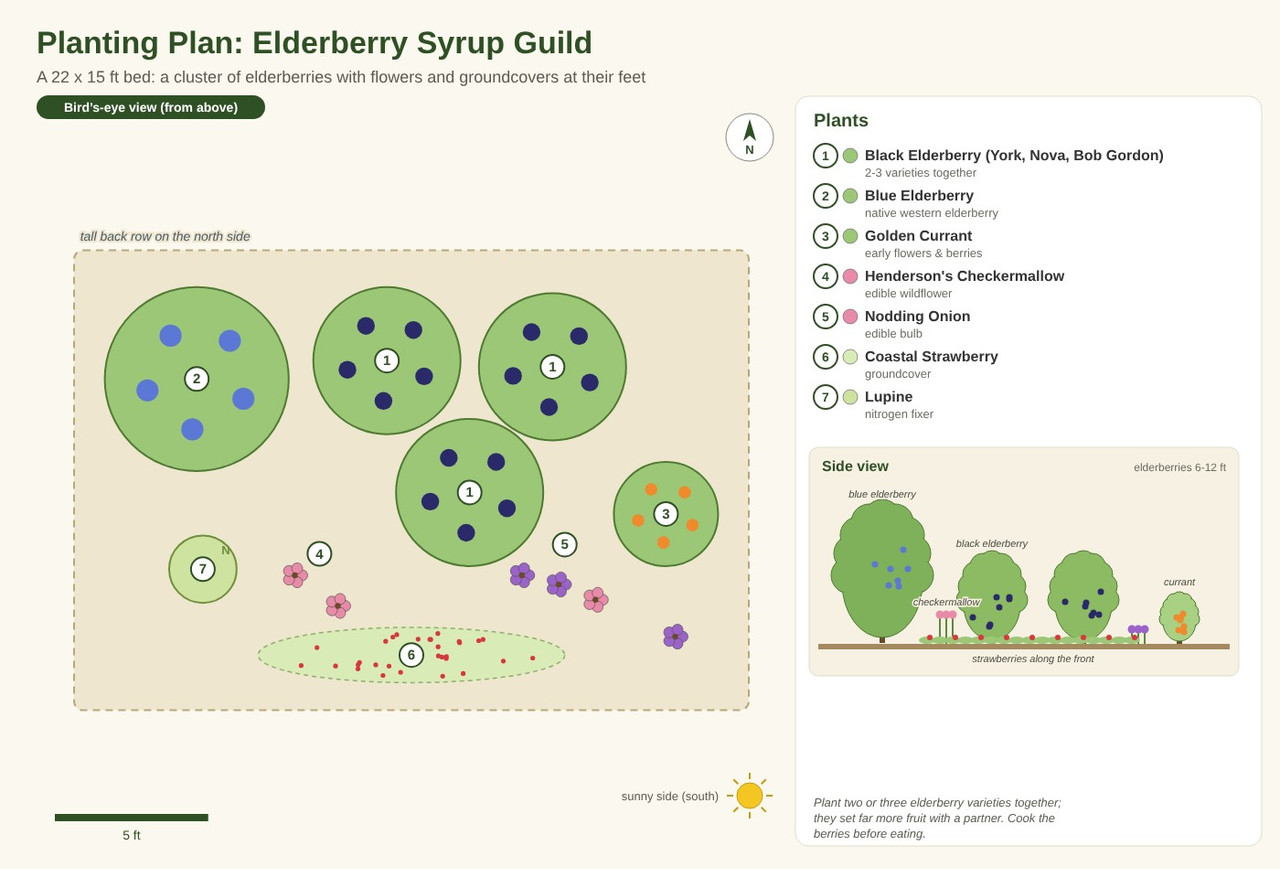
Back row: Blue Elderberry at one end and the Black Elderberry varieties in a loose triangle, 6–8 ft apart.
Sunny end: Golden Currant at the sunniest corner.
Front: Henderson's Checkermallow and Nodding Onion in small drifts, with Coastal Strawberry along the front edge.
Edge: Lupine on a dry, sunny edge. Plan on a bed about 22 x 15 ft.
Choosing a Site
Light: Full sun to light shade; more sun means more berries.
Soil: Most garden soils; elderberries like it moist and rich.
Water: Regular water the first two summers, then moderate. Fruit is bigger with summer water.
Planting Steps
Plant the elderberries first, in fall or early spring, in a group rather than a single row.
Add the currant, then the checkermallow and onions in front.
Plant the strawberries along the edge and the lupine on the driest spot, then water in and mulch.
Care & Establishment
Year one: Water regularly; elderberries grow fast once their roots settle.
Mulch: Keep 2–3 inches of mulch over the roots.
Pruning: Each winter, remove the oldest, weakest canes to keep the clump productive.
Patience: Expect a first crop in year two or three.
Guild Notes
Safety: Cook elderberries before eating. Raw berries, leaves, stems, and roots can cause nausea.
Harvest: Pick whole clusters when every berry is dark, then strip the berries off with a fork.
Flowers: Elderflowers are edible too, for cordials and fritters — but every flower you pick is a berry cluster you won't get.
