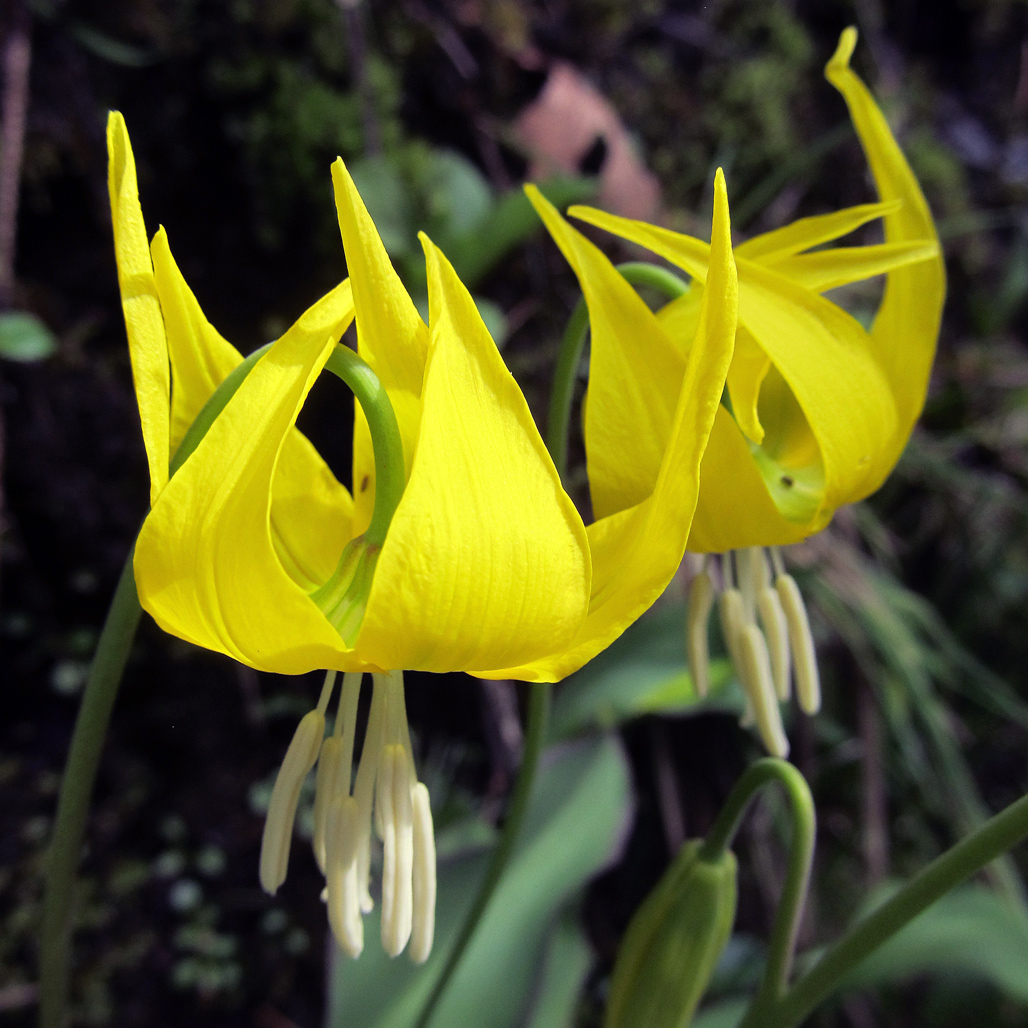
The Avalanche Lily (Erythronium grandiflorum) — also called glacier lily or yellow avalanche lily — is a radiant subalpine wildflower whose lemon-yellow blossoms follow the melting snow, and whose deep corm is a celebrated mountain root food.2, 3
Offered as a bundle of 3 bare-root plants — see the Planting Guide tab for bare-root handling.
NOTE: Bare-root plants arrive dormant (no leaves) and without soil.
Edible & Medicinal Uses
The prize is the deep-seated corm, a treasured wild food across the mountain West. It is traditionally pit-cooked for many hours, then dried and stored or strung for trade, and simmered into soups and stews with fish or meat.3 Aging or "wilting" the corms before cooking sweetens them (their inulin converts to fructose) — a trick the grizzlies know too, leaving dug corms in the sun to ripen. The young leaves and the green seedpods are also good cooked (the pods taste like green beans).4
Please cook the corms: eaten raw or in quantity they can upset the stomach, and handling raw corms may irritate sensitive skin. Crushed corms have also long been used as a soothing poultice for boils and burns — traditional use, not medical advice.4
Ornamental Qualities
Few sights rival a subalpine slope lit by glacier lilies. Each slender, arching stem lifts one to three nodding, lemon-yellow flowers with swept-back tepals above a pair of glossy, solid-green leaves.1 A true spring ephemeral, it blooms the moment the snow pulls back and then slips into dormancy — luminous in a cool rock garden, at a woodland edge, or naturalized into a drift.2
Environment & Culture
Ecology: Avalanche Lily carpets subalpine and alpine meadows and avalanche slopes from California to Alberta and New Mexico, blooming at the snow's edge from late spring into summer.1 Its early flowers feed bumblebees and migrating hummingbirds, while its corms are a preferred food of grizzly and black bears — which dig and, in scattering them, effectively "farm" the patches — and marmots and rodents cache them, while deer and elk graze the foliage and pods.2, 4
Culture: The corms are a valued root food for many Interior Plateau peoples — among them the Secwepemc, Nlaka'pamux, St'at'imc, Syilx (Okanagan), and Ktunaxa, who call it maxa — dug at snowmelt, pit-cooked, dried, and traded between nations, with digging grounds long tended by controlled burning.3 Because harvesting the corm ends the plant's life and wild stands have been badly reduced, growing your own is the kindest way to share in this First Food. We offer it with respect for that living knowledge and invite support for Indigenous-led restoration through our Charitable Giving page.3
In the Kitchen
Treat the aged corms like a sweet mountain potato: pit-roast or slow-boil them until tender, fold them into hearty soups and stews, or dry them for winter. Cook the young leaves as a green and the plump green seedpods like green beans. Go slowly the first time — and always cooked, never a big raw helping. (Growing and bare-root details are on the Planting Guide tab.)
Attributes
- Native Range: CA to Alberta to NM; subalpine/alpine meadows & avalanche slopes1
- USDA Zones: ~3–71
- Light: Part shade to filtered sun (cool)2
- Water: Cool and moist in spring; drier in summer dormancy2
- Soil: Humus-rich, well-drained1
- Habit: Corm perennial, ~6–12 in; nodding lemon-yellow flowers2
- Edible: Corms, young leaves & green seedpods — cooked3
References
- USDA Forest Service & CalScape, Erythronium grandiflorum (yellow avalanche-lily).
- Pojar, J. & MacKinnon, A., Plants of the Pacific Northwest Coast, 2014.
- Turner, N.J. & Kuhnlein, H.; Loewen, Turner & Thomas (2016), "Yellow Glacier Lily: An Important Root Vegetable of the Northwest Interior Plateau."
- E-Flora BC; Friends of Kananaskis Country; foraging references on Erythronium (ecology & cautions).