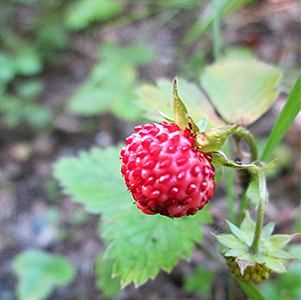
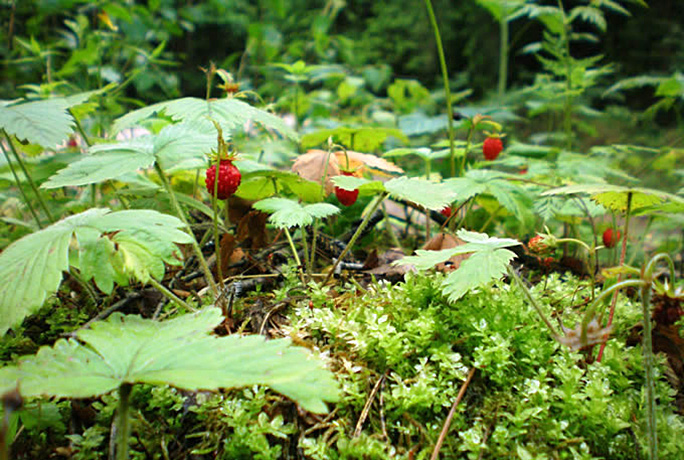
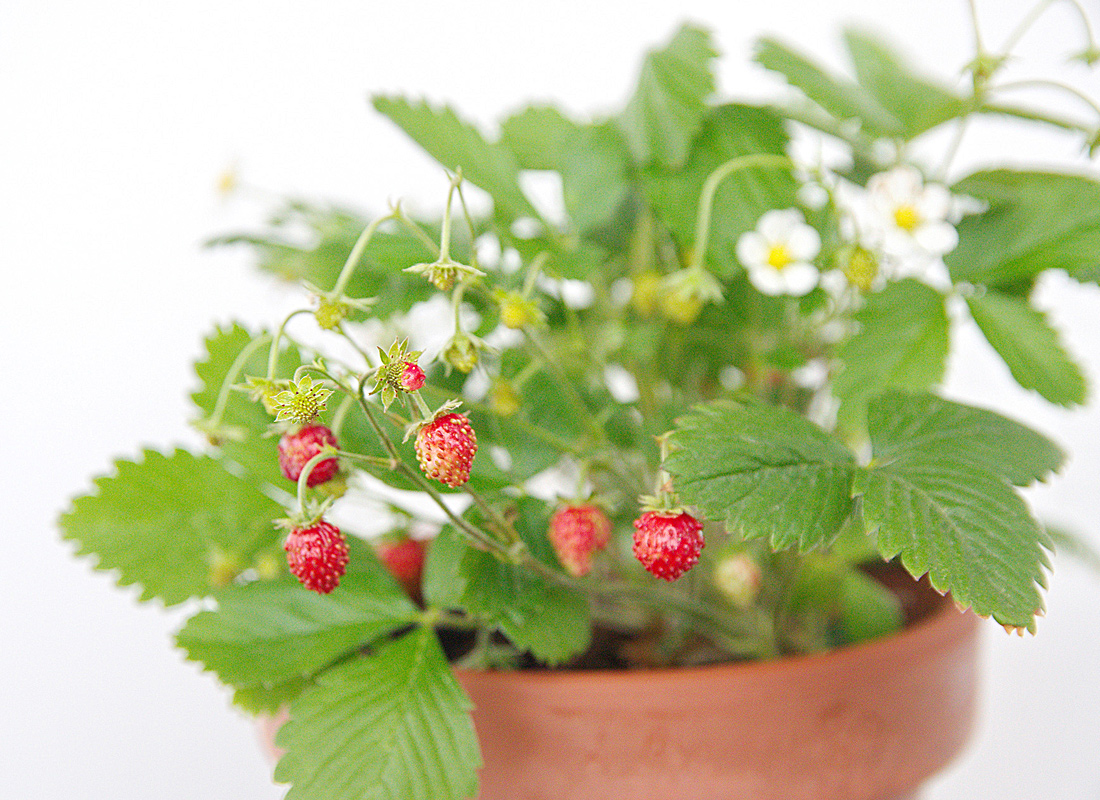
The Woodland Strawberry (Fragaria vesca) is the dainty wild strawberry of forest edges and clearings — delicate three-part leaves, starry white flowers, and tiny, fragrant red berries with a flavor far bigger than their size.2, 4
Offered as a bundle of 3 bare-root plants — see the Planting Guide tab for bare-root handling.
NOTE: Bare-root plants arrive dormant (no leaves) and without soil.
Edible & Medicinal Uses
The little conical berries are the essence of strawberry — aromatic and sweet, if a touch drier and seedier than the beach strawberry. They're a delight fresh, wonderful in jam and baked into pies (a classic paired with rhubarb), and the leaves make a mild, pleasant tea long valued as a gentle tonic. Wild strawberries have been gathered as a seasonal treat across the Northwest for generations.1, 4
Ornamental Qualities
A charming, low deciduous groundcover, Woodland Strawberry weaves bright green trifoliate foliage and white flowers through shady and dappled spots, spreading gently by runners. It's perfect softening a woodland path or bed and combines beautifully with Redwood Sorrel, Lady Fern, and the violets.4
Environment & Culture
Ecology: Native across temperate North America and Eurasia, Woodland Strawberry grows along woodland edges, clearings, and open slopes, often on warm south-facing ground. Its flowers feed early pollinators and its fruit is relished by birds and small mammals.1, 2
Culture: Wild strawberries are gathered fresh and dried as a seasonal food by many peoples, and the leaves used as a mild medicinal tea. We offer it with respect for that knowledge and invite support for Indigenous-led restoration through our Charitable Giving page.4
In the Kitchen
These are a forager's reward — sun-warm and eaten on the spot, they're pure concentrated strawberry. If you can gather enough, they make a jam of remarkable fragrance and pair famously with rhubarb in a pie. Dry the leaves for a soothing woodland tea. (Growing and harvest details are on the Planting Guide tab.)5
Attributes
- Native Range: Temperate N. America & Eurasia; woodland edges & clearings1
- USDA Zones: ~5–93
- Light: Part shade to sun (tolerates more shade than beach strawberry)4
- Water: Moderate; moist woodland conditions4
- Soil: Humus-rich, well-drained4
- Habit: Low deciduous groundcover; spreads by runners4
- Bloom: White, spring4
- Edible: Small, fragrant, sweet berries; leaves for tea4
References
- WNPS, "Three Wild Strawberries of the PNW"; USDA PLANTS, Fragaria vesca.
- Pojar, J. & MacKinnon, A., Plants of the Pacific Northwest Coast, 2014.
- USDA PLANTS Database, Fragaria vesca.
- Portland Nursery; Native Plants PNW, Fragaria vesca.
- "Edible Native Berries," Habitat Horticulture PNW.