

Great Camas ~ Bundle of 3 Bare-root
- Current Stock:
- 0
- Other Names:
- Large Camas, Leichtlin's Camass, Wild Hyacinth, Camas
- Latin Name:
- Camassia leichtlinii
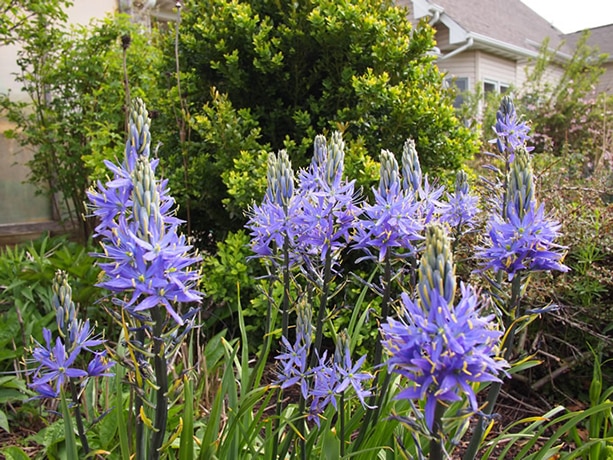
The Great Camas (Camassia leichtlinii) is the tall, stately cousin of common camas — spires of large, star-shaped blue-violet flowers rising 2–4 ft over grassy meadows in late spring, from one of the Northwest's most cherished traditional root foods.2, 4
Offered as a bundle of 3 bare-root plants — see the Planting Guide tab for bare-root handling.
NOTE: Bare-root plants arrive dormant (no leaves) and without soil.
Edible & Medicinal Uses
Camas bulbs are prized for their sweetness — but that sweetness has to be coaxed out by long, slow cooking. Raw, the bulbs are hard and largely indigestible; cooked slowly for many hours (traditionally pit-steamed for 24–48 hours), their inulin converts to fructose and they turn soft, dark, and richly sweet, tasting of baked pear, fig, or sweet potato — and the longer they cook, the sweeter they get. Great camas offers larger bulbs than common camas and was harvested, pit-cooked, and often pressed into cakes for winter and trade.1, 4
Ornamental Qualities
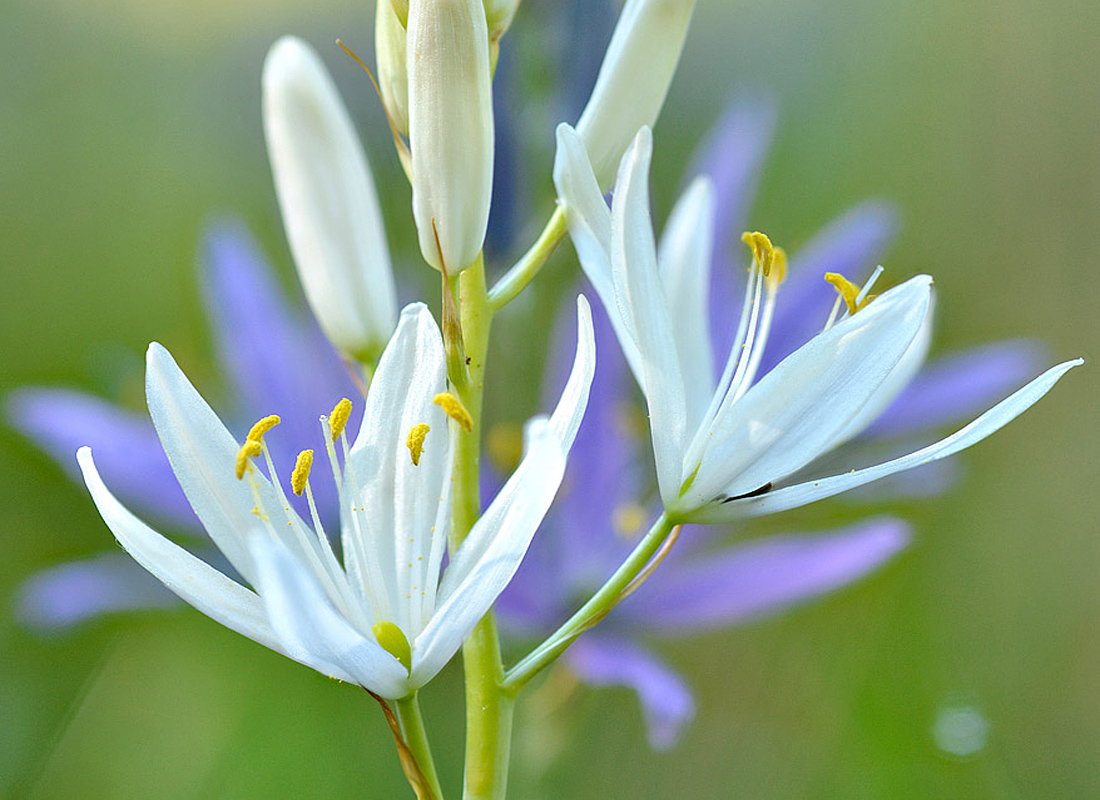
Simply spectacular in bloom, Great Camas sends up bold spikes of large blue to blue-violet (occasionally creamy) flowers, taller and later than common camas, lighting up a spring meadow, border, or pond edge. It naturalizes into breathtaking drifts and pairs classically with Oregon White Oak, Common Camas, and native wildflowers.4
Environment & Culture
Ecology: Native from British Columbia to California, Great Camas grows in moist meadows, prairies, and oak savannas that are wet in spring and dry by summer. Its flowers are a rich nectar source for native bees, and camas meadows are a signature habitat of the region's oak country.1, 4
Culture: Camas prairies are among the most important tended food landscapes of the Northwest and Plateau — cultivated with controlled burning, weeding, and selective harvest, the bulbs pit-cooked into a staple and a major trade good. We offer camas with deep respect for that living knowledge and invite support for Indigenous-led restoration through our Charitable Giving page.4
In the Kitchen
Plan for patience: camas rewards slow cooking. After the plant is done flowering and the bulbs are dug, roast or steam them low and slow for many hours (even a day or more) until they turn amber and sweet — a modern oven or slow cooker can stand in for the traditional pit. Enjoy them like a sweet, caramelized root, or mash them to sweeten other dishes.5 A note of respect and caution: a toxic look-alike called death camas can grow in the same meadows; the two differ in their flowers and bulbs on close inspection, but the resemblance is real — so never gather camas from the wild without expert guidance. (Growing and harvest details are on the Planting Guide tab.)
Attributes
- Native Range: British Columbia to California; moist meadows & oak savanna1
- USDA Zones: ~4–83
- Light: Full sun to part shade4
- Water: Moist in spring, dry in summer (summer-dormant)4
- Soil: Rich, seasonally moist; tolerates clay4
- Habit: Bulb perennial, 2–4 ft; blue-violet flower spikes, late spring2
- Edible: Bulbs — sweet only after long, slow cooking (never raw)1
References
- USDA NRCS Plant Guide; Wikipedia, Camassia.
- Pojar, J. & MacKinnon, A., Plants of the Pacific Northwest Coast, 2014.
- USDA PLANTS Database, Camassia leichtlinii.
- Confluence Project, "The Profound Role of Camas"; Turner & Bell ethnobotany.
- "Cooking Great Camas," The Backyard Larder.
Planting Guide: Great Camas (Camassia leichtlinii) — Bundle of 3 Bare-root
Tip: Plant it where the ground is moist in spring and dries out in summer — a meadow, border, or pond edge — and let it naturalize into tall blue drifts.
When Your Plant Arrives
Open the package promptly. Your plants arrive as dormant bulbs or corms — no leaves and no soil, which is normal and how they travel best. Keep them cool, dry, and out of direct sun, and plant within a few days (sooner is better); if you must wait, store them somewhere cool and dark, not damp. Plant at the depth noted below, pointed end up. If anything looks amiss, please contact customer service within 7 days of delivery and we’ll make it right.
Choosing a Site
Light: Full sun to part shade.
Soil: Rich, seasonally moist (spring-wet, summer-dry); tolerates clay.
Space: 4–6 in apart; plant generously for drifts.
Planting Steps
Plant bulbs in fall, 3–5 in deep, pointed end up; firm and water in, and mulch lightly.
Let the foliage die back naturally after bloom to feed the bulb.
Watering & Care
Establishment: Keep moist through spring growth.
After establishment: Wants a dry summer dormancy — avoid summer irrigation, which rots the bulbs.
Maintenance: Leave undisturbed to multiply into drifts; divide only if crowded, in fall.
Protection
Deer: Foliage sometimes grazed; bulbs generally left.
Wildlife: Rich nectar for native bees.
Companions: Oregon white oak, common camas, meadow wildflowers.
Harvest Basics
Safety first: Camas bulbs are nearly identical to those of death camas, which is poisonous and often grows in the very same meadows. Flower color won’t sort them out — edible camas ranges from blue-violet to creamy white depending on the species, and death camas is pale cream too, so a pale flower alone tells you nothing. Identify by the whole plant in bloom: camas bears large, showy, six-pointed star flowers up a tall spike, while death camas has smaller, tighter cream-to-greenish flowers in a denser cluster. Positively identify each plant in flower, mark your edible camas when it blooms, and never eat a bulb you can’t trace to a plant you saw flowering. When in doubt, don’t.
Season: Dig after flowering, once foliage matures.
Prep (essential): Cook long and slow (hours to a day — traditionally pit-steamed) until sweet and dark amber; never eat raw.
Sustainable harvest: Replant offset bulbs to keep the patch going.
