


Cascade Blueberry
- Current Stock:
- 0
- Other Names:
- Cascade bilberry, Blueleaf huckleberry
- Latin Name:
- Vaccinium deliciosum
The Cascade Blueberry is a low-growing, deciduous shrub with sweet, candy-like berries prized by hikers and wildlife alike! (Hence the species name "deliciosum".)
Edible Uses
Cascade Bilberry produces small, deeply flavored berries, often described as sweeter and more aromatic than most huckleberries [1]. They can be enjoyed fresh, dried, frozen, or cooked into jams, pies, syrups, and baked goods [1][2].
Nutritionally, they’re rich in vitamin C, with smaller amounts of A and B vitamins, minerals such as potassium and iron, and powerful anthocyanin antioxidants [3]. These compounds support circulation, boost immunity, and provide the berry’s rich color.
Ornamental Qualities
This low, rhizomatous shrub forms attractive clumps, usually 1–3 feet tall, with delicate, pinkish urn-shaped flowers in late spring [4]. In fall, its foliage often glows red or bronze, making it a subtle but striking groundcover in alpine gardens.
Pair it with other acid-loving species in our nursery, such as Evergreen Huckleberry, Oval-leaf Huckleberry, or native ferns. For more structure, consider pairing with Blue Blossom Ceanothus—just don’t let it block the sunlight.
Environment and Culture
Cascade Bilberry is native to subalpine and alpine meadows and open conifer forests from British Columbia through Washington, Oregon, and into northern California, usually between 2,000–6,500 feet elevation [1][4].The berries are an essential food source for bears, birds, and small mammals [5].
Indigenous peoples of the Pacific Northwest—such as the Interior Salish and others—traveled to high elevations each summer to harvest them. Some communities used fire to encourage larger berry patches and improve productivity [6]. Despite cultural disruption, Indigenous stewardship of Vaccinium species continues today, and both the people and the plants deserve our respect, gratitude, and reparations. (See our charitable giving page for more info.)
Harvest, Care, and Preparation
Cascade Bilberry can be challenging to cultivate outside of its cool mountain range but rewards patience. It prefers acidic (pH 4.5–6), well-drained, organic-rich soils—mimicking forest duff. Shallow roots benefit from mulch with pine needles, bark, or rotting wood.
-
Watering: Keep soil consistently moist for 1–3 years. Supplemental summer water increases yield.
-
Heat: Young plants are sensitive to summer heat and may need partial shade in hot, low-elevation gardens.
-
Harvest: Expect berries in 2–4 years, ripening mid-summer to late August [1][2]. Use them as you would blueberries—fresh, dried, baked, or preserved.
In the Kitchen
These tiny mountain berries are candy-sweet straight off the plant. Fold them into pancakes, muffins, and pie, cook them into a deeply flavored jam or syrup, or dry and freeze them to carry the alpine summer into winter.
Attributes
- Native Range: Pacific Northwest—British Columbia south through Washington, Oregon, and northern California; montane to subalpine zones [1][4]
- Elevation: Common from 2,000–6,500 ft in open, high-elevation meadows and coniferous forests [1][5]
- USDA Zones: 5–8 [1]
- Growth Habit: Low, rhizomatous deciduous shrub, typically 8–18 inches tall; occasionally reaching up to 3 ft in favorable sites [1][4]
- Plant Spacing: Space plants 18–36 inches apart to allow rhizomatous spread and natural colony formation [1][5][7].
- Soil: Prefers acidic, moist, well-drained soils rich in organic matter [1][4]
- Light: Full sun to partial shade; thrives in subalpine openings [4][5]
- Water: Moisture-loving; moderate drought tolerance once established [1]
- Wildlife: Fruit eaten by bears, grouse, songbirds, and small mammals; foliage browsed by deer [1][5]
- Pollination: Insect-pollinated (bees, bumblebees); self-fertile [1]
- Cultural Ecology: Traditionally tended and burned to enhance berry yields by Indigenous peoples of the Northwest [2][6]
References
[1] USDA NRCS. Plant Guide: Vaccinium deliciosum. plants.usda.gov.
[2] Turner, N. J. Food Plants of Coastal First Peoples. UBC Press, 1995.
[3] Advanced Health. “Health Benefits of Huckleberries.” Advanced Health Handout, 2024.
[4] Pojar, J., & MacKinnon, A. Plants of the Pacific Northwest Coast. Lone Pine Publishing, 1994.
[5] USDA Forest Service Fire Effects Information System. “Vaccinium deliciosum.” fs.usda.gov.
[6] Boyd, R. (ed.). Indians, Fire, and the Land in the Pacific Northwest. Oregon State University Press, 1999.
[7] Washington State University Extension. Establishing Huckleberries in Forest Openings (EB2003E) and Native Plants for the Pacific Northwest Coast (PNW 804). Pullman, WA: Washington State University Extension Service, 2014
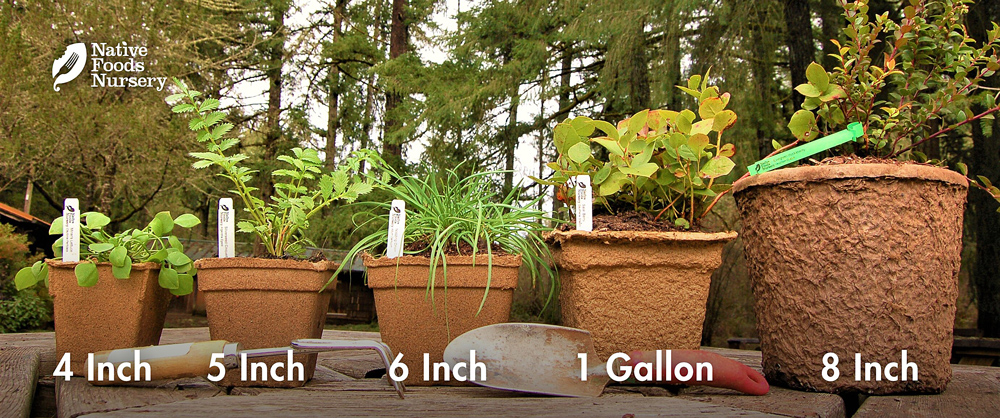
Pot Sizing Guide
Planting Guide: Cascade Blueberry (Vaccinium deliciosum)
Tip: Think “forest mimicry.” Recreate a moist, acidic subalpine understory with mulch, organic soils, and protection from summer heat to keep Cascade Bilberry happy.
When Your Plant Arrives
Open the box promptly and lift your plant out gently, holding the pot rather than the stem. Leave it in its biodegradable eco-pot for now — the roots are settled and don’t need disturbing yet. Give it a slow, thorough drink until water runs through the bottom, then set it somewhere bright but sheltered, out of harsh afternoon sun, drying wind, and frost. Let it rest and acclimate there for a few days before planting, so the move from our greenhouse to your garden is a gentle one. If anything doesn’t look right, please contact customer service within 7 days of delivery and we’ll take care of you.
Choosing a Site
Light: Full sun to part shade; fruits best with at least 6 hours of sun.
Soil: Very acidic (about pH 4.5–6), moist but well-drained, enriched with bark, needles, rotted wood, or peat.
Making it acidic: Mulch alone won’t lower a neutral or alkaline soil enough. Ahead of planting, work elemental (soil) sulfur into the bed at the label rate and give it a few months to react, blend in peat moss and composted conifer bark or needles, and feed with an organic acidic (rhododendron/azalea/berry) fertilizer. Check pH with an inexpensive meter and top up sulfur as needed — acidifying is gradual and ongoing. Where the ground stays stubbornly alkaline, grow it in a raised bed or large container of acidic mix instead.
First-years shade: A subalpine plant used to cool mountain meadows — screen it from hot afternoon sun while young (forest edge, dappled light, or shade cloth) and mulch deeply to keep the roots cool. Keep it up the first few years, longer in hot valleys.
Space: In groups 3–4 ft apart.
Planting Steps
Plant after frost risk has passed (late spring to early summer).
If it came in a biodegradable eco-pot, plant it pot and all — the pot is pressed from composted cow manure, so it melts into the soil and gives the young roots their first feed. No need to remove it.
Prepare a wide hole amended with decomposed bark, rotted wood, or peat; set at the depth it grew, backfill, firm, and water in.
Mulch with conifer needles or bark.
Watering & Care
Establishment: Keep evenly moist through the first one to three years (longer in hot, dry areas).
After establishment: Moderately drought-tolerant but fruits best with summer water.
Summer heat: Provide afternoon shade and deep mulch in hot spots; refresh acidic mulch yearly.
Protection
Birds & bears: Love the fruit; netting or fencing may be needed.
Companions: Evergreen and oval-leaf huckleberry, or native ferns, for mutual shelter.
Harvest Basics
Timeline: First berries in 2–4 years.
Season: Mid-summer into late August.
Use: Aptly named — superb fresh, dried, baked, or in jams, syrups, and pressed berry cakes.
