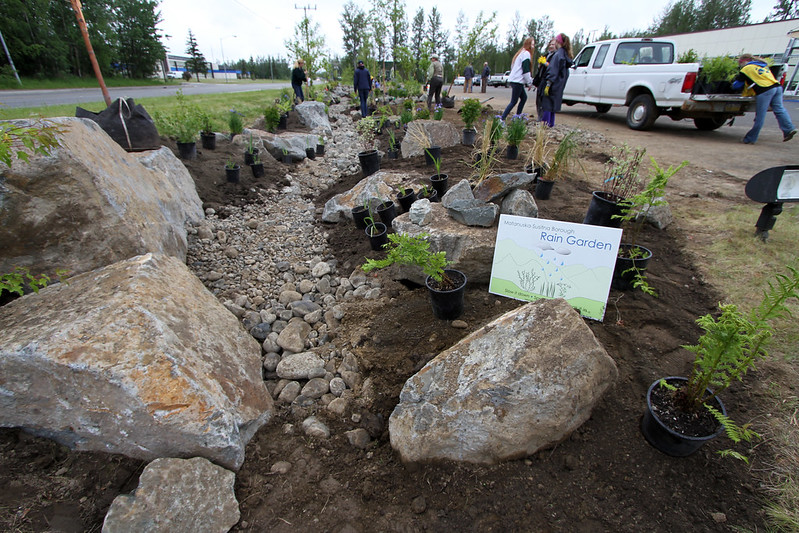
Wetland Garden/Rain Garden Guild

Current Stock:
0
Example of a Native Plant Guild:
***For Reference Only - Not For Purchase***

For the wet, mucky, or downspout-soaked corner — or a new pond edge: ten plants that love wet feet.

What Is a Guild?

A guild is an idea borrowed from nature and from permaculture: a community of plants chosen to support one another. Instead of a lonely row of a single crop, a guild layers a central tree or shrub with companions that feed the soil, draw in pollinators, cover bare ground, and yield food — each sharing light, water, and nutrients the way a small patch of wild woodland or meadow does. Plant one, and you're not just gardening; you're starting a little ecosystem.

The Wetland & Rain Garden Guild

Two of these plants prefer to be submerged (Wapato and Cattail), and the pond-lily is fully aquatic; the rest simply tolerate wet, waterlogged ground. The guild takes the beautiful native Pacific Crabapple as its centerpiece, rings it with wet-loving berries, and fills in with edible spreading roots and vigorous marsh vegetables. Put the aquatics in the pond, the rest around the edges — or grow the whole thing in a rain garden.

Plants in This Guild

  • Pacific Crabapple — centerpiece wetland fruit tree
  • American Cranberry — wetland berry
  • Black Gooseberry — moisture-tolerant berry
  • Great Yellow Pond-lily (Wokas) — aquatic — edible seed First Food
  • Wapato (Indian Potato) — submerged edible tuber — First Food
  • Cattail — marsh vegetable ("nature's supermarket")
  • Panicled Bulrush — moist-loving edible root
  • Pacific Silverweed — spreading edible root
  • Northwest Territory Sedge — wetland grain sedge
  • Pacific Waterleaf — wildflower green
  • Springbank Clover — nitrogen-fixing edible root

These are the plants we'd reach for — mix, match, and add your own. See each plant's own page for full details, and the Planting Guide tab for how to lay the guild out.

Ecology & Design

Wetlands are among the most productive habitats on earth, and this guild puts that abundance to work: wokas seed and wapato tubers were canoe-harvested staples of the Klamath and other peoples, cattail offers food in every season, and the sedge and silverweed bind the muck.12 Springbank clover fixes nitrogen along the shallow edge.3

References

  1. Turner & Szczawinski; The Klamath Tribes, Restoration Plan for Wocus (wokas as a Klamath First Food).
  2. Pojar, J. & MacKinnon, A., Plants of the Pacific Northwest Coast, 2014; Moerman, D., Native American Ethnobotany, 1998.
  3. USDA NRCS Plant Guides (nitrogen-fixing natives: Ceanothus, Shepherdia, Lupinus, Trifolium).

Planting Guide: Wetland & Rain Garden Guild

Tip: Match each plant to its water depth: fully aquatic in the pond, wet-tolerant around the muddy edges. The aquatics must never dry out.

Design & Layout

Open water: Pond-lily (wokas) and wapato, submerged in pots or muck.

Wet edge: Cattail, bulrush, sedge, silverweed, clover.

Higher, moist ground: Crabapple, cranberry, gooseberry, waterleaf.

Plan on roughly a 15-ft circle or a pond-and-margin.

Choosing a Site

Light: Full sun to part shade.

Soil: Wet to saturated; heavy, mucky soil for the aquatics.

Water: Constant — this guild is for the wet spot.

Planting Steps

Set the aquatics in submerged containers of heavy soil (see the pond-lily and wapato pages).

Plant the wet-edge species in the saturated margins.

Site the crabapple and berries on the slightly higher, moist ground.

Care & Establishment

Year one: Keep the soil wet to saturated; the aquatics must never dry out.

Mulch: Mulch bare soil (leaf mold, wood chips) until the groundcovers close in.

Weeding: Keep weeds down the first season or two; after that the guild largely mulches itself.

Patience: Trees, corms, and shrubs settle over a few seasons — the guild fills in and improves each year.

Guild Notes

Depth: Wokas and wapato want standing water; cattail and bulrush like their feet wet; the crabapple just wants moist ground.

First Foods: Wokas seed and wapato tubers are the celebrated harvests here.

Vigor: Cattail and pond-lily spread — contain them if the space is small.