




California Foothill Pine

- Current Stock:
- 0
- Other Names:
- Gray Pine, Ghost Pine, Foothill Pine, Bull Pine, Sabine Pine
- Latin Name:
- Pinus sabiniana
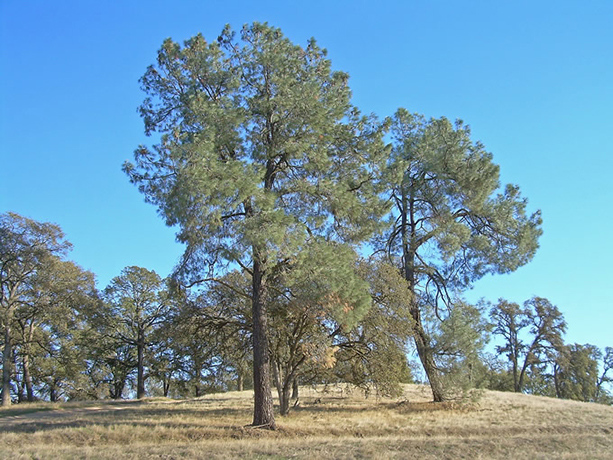
The California Foothill Pine (Pinus sabiniana), also called Gray or Ghost Pine, is an airy, silvery-needled native pine of the western foothills — famous for its huge, heavy cones and their large, rich, edible pine nuts.2, 4
Edible & Medicinal Uses
This pine bears some of the finest native pine nuts — large, sweet, and oil-rich seeds nestled in massive woody cones. Prized for their flavor and dense nutrition, they're delicious raw or lightly roasted, eaten by the handful or added to dishes much like commercial pine nuts. They are a major traditional food, and the green immature cones and seeds are eaten as well. (The soft, edible seed coat cracks easily to release the kernel.)1, 4
Ornamental Qualities
Unmistakable and sculptural, Foothill Pine casts a soft, open, "ghostly" silhouette of long, drooping, silvery-gray-green needles on an often forking trunk, 40–80 ft. Its lacy, light-filtering canopy makes it one of the best pines to underplant, and it thrives in hot, dry, poor sites where little else will — a dramatic, drought-tough specimen tree.1
Environment & Culture
Ecology: Endemic to California's foothills (edging into southern Oregon), Foothill Pine is superbly adapted to hot, dry, low-nutrient ground. Its enormous cones and nutritious seeds are a bounty for woodpeckers, jays, squirrels, and other wildlife, and its open canopy shelters an understory of oaks and shrubs.1, 4
Culture: The large, oily seeds are a staple food for many California nations, gathered from the great cones and eaten raw, roasted, or ground; the green cones and seeds are eaten too. We offer this tree with respect for that living knowledge and invite support for Indigenous-led restoration through our Charitable Giving page.4
In the Kitchen
Collect the great cones as they ripen in fall, pry the large seeds from between the scales, and crack the soft shells to free the rich kernels. Eat them raw for a buttery, resinous sweetness, or toast them lightly to deepen the flavor and scatter over salads, grains, and roasted vegetables like any pine nut. (Growing and harvest details are on the Planting Guide tab.)
Attributes
- Native Range: California foothills, edging into southern Oregon1
- USDA Zones: ~7–93
- Light: Full sun1
- Water: Very drought-tolerant; thrives on dry, poor sites1
- Soil: Lean, rocky, well-drained; tolerant of poor ground1
- Habit: Evergreen pine, 40–80 ft; airy, gray, open canopy1
- Edible: Large, rich pine nuts (raw or roasted)4
References
- CalScape; USDA PLANTS, Pinus sabiniana.
- Pojar, J. & MacKinnon, A., Plants of the Pacific Northwest Coast, 2014.
- Oregon State University Landscape Plants; Jepson eFlora, Pinus sabiniana.
- Native Foods Nursery field notes; Anderson, M. K., Tending the Wild, 2005.
Pot Sizing Guide
Planting Guide: California Foothill Pine (Pinus sabiniana)
Tip: This is the pine for a hot, dry, difficult spot — give it full sun and sharp drainage and it thrives on neglect, casting light, airy shade you can plant beneath.
When Your Plant Arrives
Open the box promptly and lift your plant out gently, holding the pot rather than the stem. Leave it in its biodegradable eco-pot for now — the roots are settled and don’t need disturbing yet. Give it a slow, thorough drink until water runs through the bottom, then set it somewhere bright but sheltered, out of harsh afternoon sun, drying wind, and frost. Let it rest and acclimate there for a few days before planting, so the move from our greenhouse to your garden is a gentle one. If anything doesn’t look right, please contact customer service within 7 days of delivery and we’ll take care of you.
Choosing a Site
Light: Full sun.
Soil: Lean, rocky, well-drained; it thrives on poor, dry ground.
Space: 20+ ft; it forks and spreads into an airy gray-green canopy.
Planting Steps
Plant in fall or winter while cool.
If it came in a biodegradable eco-pot, plant it pot and all — the pot is pressed from composted cow manure, so it melts into the soil and gives the young roots their first feed. No need to remove it.
Set at the depth it grew, backfill, firm, water in, and mulch off the trunk.
Watering & Care
Establishment: Water occasionally through the first couple of dry summers.
After establishment: Very drought-tolerant; avoid overwatering, which rots the roots.
Protection
Deer: Generally left alone.
Wildlife: The huge cones and big seeds feed woodpeckers, jays, and squirrels; the open canopy shelters an understory.
Note: The massive, spiny cones are heavy — site the tree away from paths, seating, and parking where a falling cone could do harm.
Harvest Basics
Season: Fall, as the great cones ripen.
Prep: Pry the large seeds from the woody cones (gloves — the cone tips are sharp) and crack the soft shells.
Use: Eat the kernels raw or lightly roasted — among the finest, sweetest, oil-rich native pine nuts.
