


Giant White Fawn Lily
- Current Stock:
- 0
- Other Names:
- Oregon Fawn Lily, Giant White Fawnlily, Fawn Lily
- Latin Name:
- Erythronium oregonum
The Giant White Fawn Lily (Erythronium oregonum) is one of the loveliest wildflowers of the Willamette Valley — nodding, creamy-white blossoms with backswept petals and golden hearts, held above beautifully fawn-mottled leaves in early spring.1, 2
NOTE: Native wildflower bulbs are dormant (no leaves/flowers) during the Summer/Fall.
NOTE: Native wildflowers are dormant (no leaves/flowers) Summer–Fall.
Edible & Medicinal Uses
Beneath the flowers sits a small, deep corm that is edible — eaten raw, cooked, or dried, though it's best enjoyed cooked and in moderation (like its relatives, the raw corm can upset the stomach if eaten in quantity).3 It is a modest food next to its famous mountain cousin, the glacier lily, but a genuine one. The crushed corm has also long been used as a simple poultice for boils — traditional use, not medical advice.3
Ornamental Qualities
This is a woodland jewel. Each slender stem arches to lift one to three nodding, creamy-white, pagoda-like flowers — petals swept back around a golden center — above a pair of glossy leaves marbled brown like a fawn's coat.1 A spring ephemeral, it blooms early and then slips underground by summer; in time it self-sows into luminous drifts, making a magical groundcover for the shade or woodland garden.2
Environment & Culture
Ecology: Giant White Fawn Lily is native to lowland oak woodlands, moist-to-dry forests, and grassy prairies west of the Cascades, from southwestern British Columbia to northern California — the Willamette Valley was once thoroughly adorned with them.2 It grows in the company of Common Camas, Oregon White Oak, and snowberry, and its early flowers offer some of the season's first nectar to bumblebees and other pollinators. An early-successional plant of open woodland, it is now declining with the loss of oak-prairie habitat — so growing it is a real contribution to restoration.1, 2
Culture: Fawn-lily corms are gathered and eaten as a minor root food by some Northwest peoples, dug at dormancy and cooked — the celebrated glacier lily of the high country being the better-known food of the genus. We offer it with respect for that living knowledge and invite support for Indigenous-led restoration through our Charitable Giving page.3
In the Garden & Kitchen
Grow it first for its beauty and for the oak-prairie community it belongs to. If you'd like to taste it, lift only a few of your own cultivated corms in summer dormancy, cook them like a small potato, and leave plenty (and any offsets) to carry the patch forward. (Growing details are on the Planting Guide tab.)
Attributes
- Native Range: SW BC to N California, west of the Cascades; oak woodland, forest, prairie1
- USDA Zones: ~5–83
- Light: Full sun to full shade (part shade prolongs bloom)1
- Water: Moist in spring; dry summer rest (do not water in summer)2
- Soil: Well-drained; tolerates clay; upland, never boggy1
- Habit: Spring-ephemeral corm perennial, 8–16 in; creamy-white nodding flowers2
- Edible: Small corm (cooked, in moderation)3
References
- USDA PLANTS & Flora of North America; CalScape, Erythronium oregonum.
- Pojar, J. & MacKinnon, A., Plants of the Pacific Northwest Coast, 2014; regional native-plant sources (Willamette Valley decline & cultivation).
- Plants For A Future (edibility & poultice); Moerman, D., Native American Ethnobotany, 1998.
Pot Sizing Guide
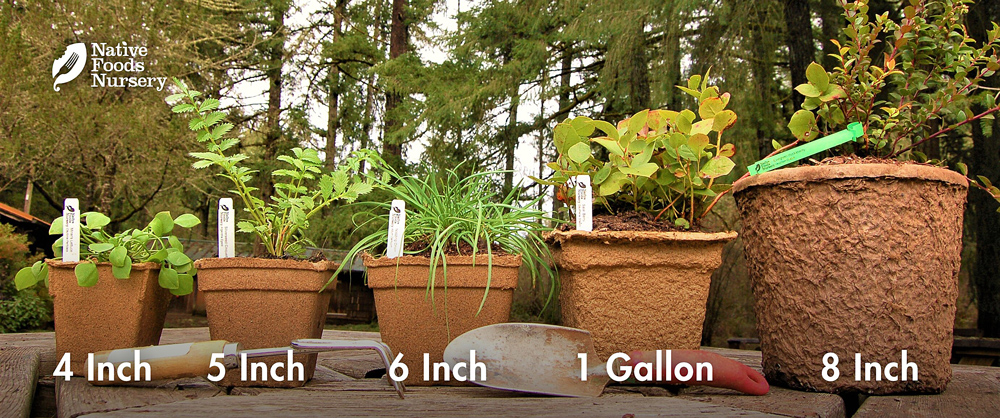
Planting Guide: Giant White Fawn Lily (Erythronium oregonum)
Tip: The one rule that matters — give it a dry summer rest. Keep it moist in spring while it grows and blooms, then stop watering and let it sleep through summer; summer water rots the corm.
When Your Plant Arrives
Open the box promptly and lift your plant out gently, holding the pot rather than the stem. Leave it in its biodegradable eco-pot for now — the roots are settled and don’t need disturbing yet. Give it a slow, thorough drink until water runs through the bottom, then set it somewhere bright but sheltered, out of harsh afternoon sun, drying wind, and frost. Let it rest and acclimate there for a few days before planting, so the move from our greenhouse to your garden is a gentle one. If anything doesn’t look right, please contact customer service within 7 days of delivery and we’ll take care of you.
Choosing a Site
Light: Full sun to full shade (part shade to shade prolongs the bloom).
Soil: Average, well-drained; tolerates clay; upland, never soggy.
Space: 4 in apart.
Planting Steps
Plant in fall at the depth the plant grew; water in to establish.
Site where summer stays dry — under deciduous trees or oaks is ideal.
Watering & Care
Spring: Keep evenly moist during growth and bloom.
Summer: Stop watering — let the foliage yellow and the plant go dormant and dry.
Maintenance: Leave undisturbed; slow to increase, forming colonies over years.
Protection
Deer & rodents: Deer graze the foliage and rodents relish the corms — protect if needed.
Wildlife: Early flowers feed bumblebees and other spring pollinators.
Harvest Basics
Best use: Grown mainly for its beauty and for oak-prairie restoration.
Corm: Edible cooked in moderation — but it is slow-growing and takes years to reach blooming size, so lift only a few cultivated corms in summer dormancy and leave the colony to build. Most gardeners simply enjoy the flowers.
