


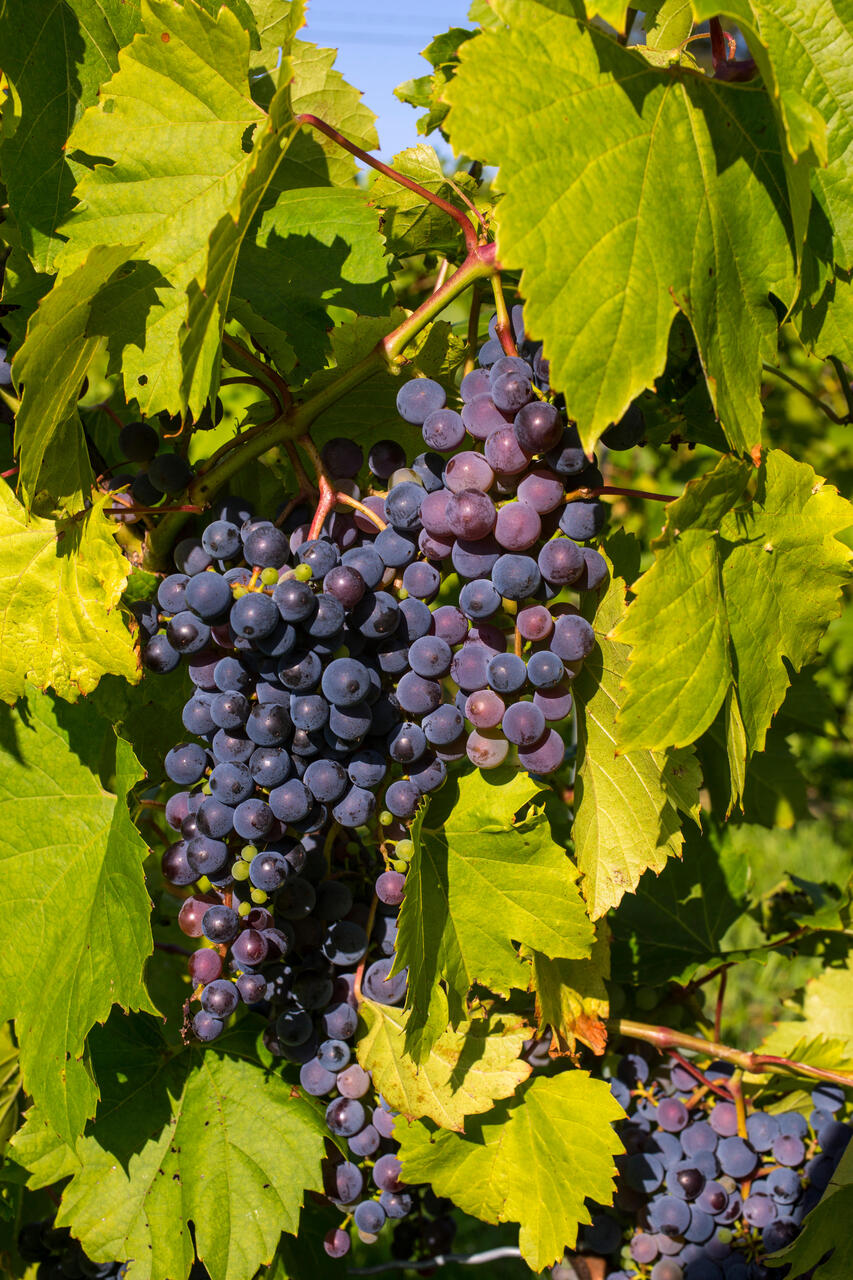
Frontenac 'Gris' - Juice-Wine Grape
- Current Stock:
- 0
- Other Names:
- Frontenac
- Latin Name:
- Landot 4511 × Vitis riparia UMN 89
Frontenac gris turns cold climates into wine country. A bud mutation of Frontenac, itself a cross of Landot 4511 × Vitis riparia UMN 89, this variety unites the cold hardiness of native riparia with the rich aroma and versatility of modern breeding [6][7][8]. Reliable even below −35 °F, Frontenac gris thrives in regenerative systems where resilience matters most.
Edible Uses
Frontenac gris is a high-sugar grape grown above all for the glass: its amber, pinkish-gray berries ripen to around 24–26 Brix and make celebrated white, rosé, and dessert wines with notes of peach, apricot, citrus, and honey [2][4][5]. The same aromatic juice makes a lovely nonalcoholic grape juice and jelly. The fruit hangs in generous clusters and keeps its lively acidity even in cool, short seasons.
Ornamental Qualities
Graceful foliage and heavy clusters make Frontenac gris a natural for arbors, fences, or vineyard rows in an edible landscape, and its warm bronze-orange fall color adds ornamental charm. Train it up a sturdy trellis, pair it with our native California Wild Grape, or get creative and let it climb a hardy Serviceberry or run along an edible hedge as a living trellis.
Environment and Culture
Ecology & Origin: Frontenac gris is a naturally occurring amber-fruited bud mutation of the grape Frontenac (Landot 4511 × Vitis riparia 89), discovered and released by the University of Minnesota grape-breeding program in 2003 [1][6]. From its wild V. riparia parentage it inherits exceptional cold hardiness (reliable below −30 °F), vigor, and disease resistance, making it a standout for cold-climate, regenerative, and permaculture vineyards [3].
Harvest, Care, and Preparation
Frontenac gris is self-fertile and exceptionally cold-hardy — reliable to roughly −30 °F — with good disease resistance and the vigor typical of its Vitis riparia parentage [2][3]. Train it to a sturdy trellis and prune annually to renew fruiting canes and keep its generous crop in balance. Harvest in fall, once the amber berries reach full sugar (around 24–26 Brix) while still holding their signature bright acidity — the balance prized for white, rosé, and dessert wines [4][5].
In the Kitchen
A high-sugar grape built for the glass: Frontenac gris is prized for white, rosé, and dessert wines with notes of peach, apricot, and citrus, and it also makes a bright, aromatic juice and jelly. Press the amber fruit fresh, or ferment it — its naturally high sugar and lively acidity are made for the bottle.
Attributes
- Native Heritage: Riparia-based (North American wild grape genetics) [1][3]
- USDA Zones: 3–8 (hardy to −35 °F) [2][6]
- Ease of Care: Easy (vigorous and disease-tolerant)
- Light Requirements: Full sun
- Soil Type: Well-drained loam or sandy loam; adaptable
- Water Requirements: Moderate; steady moisture during fruit swell
- Pollination: Self-fertile (perfect flowers)
- Bearing Age: 2–3 years from planting
- Vine Size: Vigorous climber; strong trellis recommended
- Ripening Window (PNW): Mid- to late season [4]
- Use: White, rosé, and dessert wine; also juice and jelly; high-sugar amber berries [2][4][5]
- Disease Resistance: Low to moderate disease pressure (downy mildew, bunch rots) [2][6]
NFN Grape Comparison Table
| Grape | Type & Use | Native Range / Pedigree | Flavor Notes | Cold Hardiness (approx.) | Site & Water | Notes |
|---|---|---|---|---|---|---|
| California Wild Grape Vitis californica | Wild species; fresh nibbling, jelly/juice; top wildlife vine | CA & s.w. OR riparian canyons/valleys | Classic “wild-grape” tang; better sugars in full sun/heat | ~USDA 7–9 | Full sun; deep, infrequent watering after establishment | Fast, vigorous screen/arbor vine; great for Mediterranean/coastal West. |
| Arizona / Canyon Grape Vitis arizonica | Wild species; jelly/juice; drought-tough habitat vine | S. NV–UT–AZ–NM–W. TX; N. Mexico canyons/streams | Tart-sweet; bright acidity; improves with heat | ~USDA 6–9 | Full sun; lean, well-drained soils; very drought-adapted | Used in breeding for disease tolerance; excels in arid/interior West. |
| ‘Bluebell’ V. riparia × V. labrusca | Table/juice (seeded); cold-hardy backyard favorite | UMN release (1944); ‘Beta’ × labrusca-type | Concord-like, sweet-aromatic; slipskin | to about −30 °F (Zone 3–4) | Full sun; average soils; regular summer water for best size | Best riparia-line **table** choice for cold regions. |
| ‘Frontenac gris’ (Frontenac bud mutation; Frontenac = Landot 4511 × V. riparia sel.) | Wine/juice (processing); high acids, aromatic | UMN release (2003); riparia-based breeding | Stone fruit, citrus/tropical notes in wine | to about −30 °F (Zone 3–4) | Full sun; trellis; consistent water; manage acids with harvest timing | Flagship cold-climate wine grape; not ideal as a table grape. |
References
[1] University of Minnesota grape-breeding program — Frontenac gris (released 2003; pedigree).
[2] University of Minnesota Enology — Frontenac gris factsheet (fruit, use, disease notes).
[3] USDA PLANTS / NatureServe — Vitis riparia (native range & breeding significance).
[4] Double A Vineyards — Frontenac gris cultivar page (Brix, ripening window).
[5] University of Minnesota Extension — Frontenac gris (flavor & winemaking use).
[6] North Dakota State University Extension — cold-hardiness & disease-resistance notes.
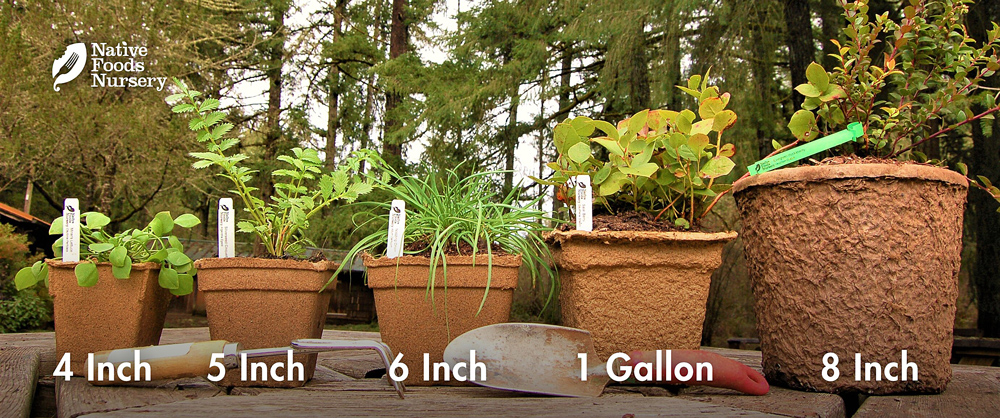
Pot Sizing Guide
Planting Guide: Frontenac gris (Vitis 'Frontenac gris')
Tip: Full sun, sharp drainage, and a strong trellis. Frontenac gris is a vigorous, high-sugar wine grape that is exceptionally cold-hardy — it thrives in rugged northern sites where vinifera grapes fail.
When Your Plant Arrives
Open the box promptly and lift your plant out gently, holding the pot rather than the stem. Leave it in its biodegradable eco-pot for now — the roots are settled and don’t need disturbing yet. Give it a slow, thorough drink until water runs through the bottom, then set it somewhere bright but sheltered, out of harsh afternoon sun, drying wind, and frost. Let it rest and acclimate there for a few days before planting, so the move from our greenhouse to your garden is a gentle one. If anything doesn’t look right, please contact customer service within 7 days of delivery and we’ll take care of you.
Choosing a Site
Light: Full sun (6–8+ hours daily).
Soil: Well-drained loam or sandy loam of moderate fertility; compost aids moisture.
Space: Along a trellis or arbor.
Planting Steps
Plant in spring once frost risk has passed; soak bare roots 30–60 minutes first.
If it came in a biodegradable eco-pot, plant it pot and all — the pot is pressed from composted cow manure, so it melts into the soil and gives the young roots their first feed. No need to remove it.
Set the crown at the prior soil line, firm, water in, and mulch.
Watering & Care
Establishment: Keep evenly moist the first 1–2 years.
After establishment: Moderate water; avoid soggy soil.
Training & Pruning
Train it to a sturdy trellis, fence, or arbor. Grapes fruit on new shoots that grow from last year’s wood, so prune hard every winter while dormant — keep a few strong canes or spurs on a permanent framework and remove the rest. Left unpruned it becomes a tangled, unproductive thicket.
Protection
Birds: They love ripe fruit — net as the berries color.
Cold: Very hardy (to roughly -30°F); mulch the roots in exposed sites.
Harvest Basics
Timeline: First fruit 2–3 years after planting.
Season: Fall, mid- to late season.
Pick: When the amber, pinkish-gray berries reach full ripeness (around 24–26 Brix).
Use: A high-sugar grape grown above all for the glass — celebrated white, rosé, and dessert wines, and good juice.
